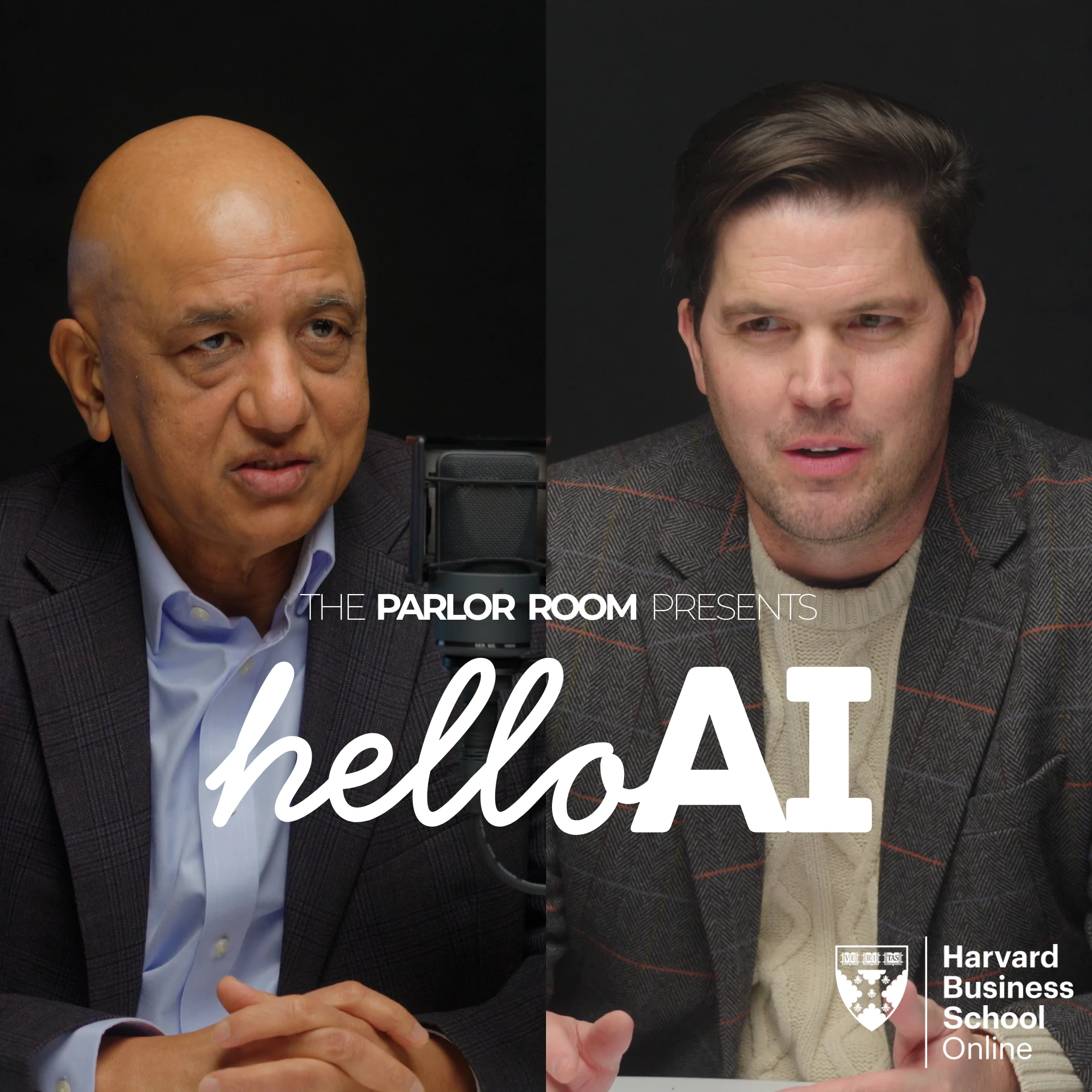
In this episode of The Parlor Room Presents: Hello AI, host and Harvard Business School Online Creative Director Chris Linnane speaks with HBS Professor Sunil Gupta about how AI is reshaping marketing. Gupta explains how generative AI is changing content creation, customer targeting, and brand strategy—and why marketers must go beyond efficiency to create meaningful differentiation.
He also explores the evolving role of human judgment, the risks of over-automation, and what it takes to build trust in an AI-driven landscape.
Resources
Catch up on previous episodes of The Parlor Room, featuring Gupta:
Plus:
Explore Gupta's HBS Online course: Digital Marketing Strategy
Watch The Parlor Room Presents: Hello AI on YouTube
Transcript
Editor's Note: The following was prepared by a machine algorithm and may not perfectly reflect the interview's audio file.
Sunil Gupta: What happens to brands? What happens to marketing? How do we actually communicate that I'm honest and trustworthy, and you are not? It used to be seeing is believing. It's no longer the case.
Voiceover: Sunil Gupta is a professor of marketing at Harvard Business School.
Sunil Gupta: There is no reason Google should not have been the first one to launch something like ChatGPT.
Chris Linnane: Yeah.
Sunil Gupta: What will happen to his search advertising, which is a $200 billion business?
Voiceover: The biggest companies in the world are figuring this out in real time.
Sunil Gupta: The fundamental value proposition and the fundamental promise of the brand has to come from people.
Voiceover: Every marketer is asking the same question right now.
Sunil Gupta: How you advertise and what tools you use is entirely up to you.
Chris Linnane: Playing on their field with your own rules.
Sunil Gupta: With your own rules.
Voiceover: This is the conversation every boardroom is having.
Sunil Gupta: Meta, and Google, and TikTok, and now, very soon, it'll be AI chatbots. And the moment advertising starts on AI chatbots, brands will be there.
Voiceover: Welcome to The Parlor Room Presents: Hello AI.
Chris Linanne: What makes you interested in AI in your field?
Sunil Gupta: So, I think it's a seismic shift, partly because AI was used for prediction before. So we've been using AI forever. For example, Netflix uses a recommendation system, or Amazon uses a recommendation system. And I have used AI since my grad days for building these prediction models. But what changed is the generative AI part, where you actually don't need to learn how to code, don't need any technical knowledge, and anybody can ask questions to a so-called expert and get responses, generate new ideas, et cetera.
And in marketing, it's a phenomenal asset because you can create new blogs, you can create new assets, you can create new images. It's like your thought partner in lots of ways.
Chris Linnane: Before AI became so central to so many conversations, was there a moment when you started to pay attention to it differently?
Sunil Gupta: So the first time I was a little bit intrigued was when DALL-E was introduced for image generation. It was not publicly available at that time, but I saw some images created by a prompt, and that was mind-boggling. Although it was still early days, they were not highly professional, but they were still intriguing that just by writing a text, you can create an image.
And then came ChatGPT in November 2022. And that was just totally mind-boggling, because suddenly it seemed like magic that you say something and generate content. So the fact that the models can generate content as if there is a human on the other side, which is the so-called Turing test that most of us couldn't even tell the difference between whether it's a human or a machine that is generating that content was totally shocking.
Chris Linnane: I had a moment like that, too, with the image generation, where the first few that I made, I was like, OK. And it felt very, you know, this kind of feels like a gimmick.
Sunil Gupta: Yes.
Chris Linnane: And then, I did a couple of product images where I thought, "That looks really good."
Sunil Gupta: Yes. And the speed at which these models improved is just awesome. Because when you see the first version of DALL-E, you say, "OK, yeah, this is a gimmick." This is like fun and games. But very soon, they improved.
Chris Linanne: We know that AI has existed in marketing for a while. How was it actually used before? And why does this moment feel different and not just louder?
Sunil Gupta: So as I said, AI in marketing was used, for example, for segmentation, for clustering. So a lot of machine learning models were used. They were used for prediction purposes. They were used for churn modeling to predict who's likely to return in a customer segment. Who should we give an offer? So a lot of those models were built, but they were built by people who knew how to write the code, how to do data analytics, how to learn all this technical expertise that is needed behind that.
What has changed is now marketing can be used by anybody. The front-line managers, you don't need a data analyst to crunch the things. A brand manager can actually use these tools to do what a data analyst was needed to do.
So suddenly, there's a change in terms of functions, the change in capability, the change in the scale of things you can do. And also, you can do new things. You can generate new ideas. You can generate new concepts. You can generate new images. You can generate new value propositions that you couldn't do before.
Chris Linnane: So, as the technologies made these big leaps and bounds advancements, how about the users, the people that are actually putting it together? What is different about maybe the mindset or the way people are using this technology now?
Sunil Gupta: So I think the users, earlier for machine learning models, used to be the data analysts, the people who knew how to maneuver and manipulate the data. And usually, the data that they were using were the numbers—the rows and columns of an Excel spreadsheet.
But there's very little manipulation of the text, or of images, or of videos. And now 90 percent of the data is non-numbers. They are not numerical. They are text images on social media and everything else. And text mining was there to summarize the information, but you couldn't generate new concepts out of it. You couldn't generate new insights out of them straight away.
And now the machines can do that for you. And an average person, without any knowledge of what goes behind the machine, can do that. It's almost like driving a car without knowing how the engine works.
Chris Linnane: Yeah, yeah. Well, I just tried the self-driving for the first time ever, and it petrified me, and it actually worked. At first, I had my hands around the steering wheel, my foot over the brake. And I thought, it actually knows what it's doing.
Sunil Gupta: I had the same reaction. I was going around the curve at 70 miles an hour. And I was like, "OK, this is crazy."
Chris Linnane: Yeah, it's alarming. All of this is making our brains work differently.
Sunil Gupta: Yeah.
Chris Linnane: A marketer hears the word "automation." And I'm in this world a little bit, too. They hear the word automation, and sometimes that word just instantly becomes "replacement" in their head. So is that fear misplaced, or that feeling of fear misplaced, or is it partially justified?
Sunil Gupta: I think if you think about any job, marketing job or any job, it consists of multiple tasks. The tasks that are rote tasks, that are repetitive tasks, that do not involve any tacit knowledge—they can be automated. But where judgment is required, where strategic thinking is required, I think those will remain the same.
So, what is happening already, and what will happen more so, is that a marketing person will look at what tasks I can actually let the machines do and what tasks I should focus more on. So marketing jobs are not going to completely go away. I think they're going to be reshuffled in terms of what we do and what we let the machines do. And that has been happening with even the technology that we had before, since the age of computers.
Chris Linnane: Yeah, so to dive a little bit deeper on that, what roles are most exposed to becoming something that AI could do already?
Sunil Gupta: The roles that are most exposed, for example, call centers. One way to think about this is, does it require tacit knowledge or not? So if you're a physician, you have some tacit knowledge. You don't want to rely completely on the machines.
And the second dimension I will say is, what is the cost of error? If the machine makes a mistake, is it catastrophic, or is it OK? So you don't want a doctor to put you on an operating table and say, "Well, the AI told me to do that."
Chris Linnane: Yeah, but a call center.
Sunil Gupta: A call center. So it's a low cost. And also, the third component is, are the users who use the output of that machine comfortable with that? So in this case, if you're a call center, would you rather wait for the call to go through in 30 minutes, or are you comfortable as a consumer to talk to a machine?
And I think, for many cases, people are comfortable. It's almost like going to the airport and not waiting for an agent. I'm happy to go to the kiosk.
Chris Linnane: Are there times when—I mean, I'm sure there are—but what's an example of a company automating maybe too quickly in the marketing world, specifically, where they put on the tracks, they set it, and it's just too fast?
Sunil Gupta: I think people are experimenting because they're all worried as to what can or cannot happen, especially large brands are worried about whether automation can impact the brand image. So, for example, in April of 2025, Mark Zuckerberg came out and said to brands, "You don't have to worry about creating content. You don't even have to worry about who your audience is. You just tell me your goal and give me your budget, and I'll do the rest. So I'll automate everything. I will figure out who's the right customer. I'll figure out what content to create. I'll figure out how to target. And I will monitor that in real time, and I will give you the results."
Sounds great. But the majority of the large brands are hesitant, because it seems like a black box. You don't have a consistency of brand image. And you don't know where your ad is showing up. If you're Disney, your ad may be showing up against some content that you're just not comfortable with.
Chris Linnane: Yeah, so say we follow the Zuckerberg plan, and he just makes all this stuff for us. What then is our differentiator? Because wouldn't he just use all the same—or wouldn't whatever system in the future just use all the same keys in all the same places?
Sunil Gupta: That's exactly the problem, that it will start looking very similar. And there is no originality. So in the early stages, it sounds great that I don't have to put the effort, and, quite honestly, the AI machines can be better in terms of parsing out all the details. And it might be useful for the small and medium brands or small and medium enterprises that don't have either the time or the resources to learn all the complexity of digital marketing. But very soon, they all look the same.
So imagine if Coke uses this—Zuckerberg's strategy of automating everything through Meta—and Pepsi also uses that, so is Meta AI for Coke competing with Meta AI for Pepsi? And then, how does it actually differentiate between those two?
Chris Linnane: Oh, that sounds horrible. It sounds like a tough place to be. This aims at that a little bit, but are there instances where we kind of overestimate what AI can do in marketing?
Sunil Gupta: I think that is certainly a concern about overestimating that we can create content, and there's a lot of conversation nowadays about AI slop, that the majority of the stuff is so, because it's so easy, we tend to do that. And that can backfire.
In fact, there are some studies which show that a large proportion, more than 50 percent of the content that is uploaded now in social media is AI-generated. But if you look at what AI chatbots pull from that content, the majority of that content is human-generated. So even the AI chatbots are distinguishing between what is created by AI versus what is created by humans.
Chris Linnane: Wow, OK, so it's intentionally looking for the human content to pull from?
Sunil Gupta: Because it's looking for something different.
Chris Linnane: Yeah. Will it ever pull from itself, and then it just becomes this horrible cycle?
Sunil Gupta: Well, so that's the concern because all these OpenAI and the Googles of the world, they have scanned almost everything that exists today in terms of data. And all these models are data hungry. So now, in order to make these models even more powerful, they need more data, except that they've already scraped everything. So, some thought is that AI will create some synthetic data on which it will train again.
Chris Linnane: Oh, my God.
Sunil Gupta: And that's like a circular logic—
Chris Linnane: Circle of slop.
Sunil Gupta: —and it's not quite clear that those models will be any better.
Chris Linnane: That makes me nervous. I'll be honest. That makes me very nervous. So, OK, we've talked about this in an abstract way, and I'm hoping we can make it a little more concrete. Are you up for playing a quick game?
Sunil Gupta: Sure.
Chris Linnane: All right, I am going to read three marketing scenarios, initiatives scenarios.
Sunil Gupta: OK.
Chris Linnane: And then, what I have here—this is good—what I have here—and for the people listening at home, I have this little board, this little board of, oh, man, there's a piece of tape stuck to it. OK. So if you look at this board, it's one line. On one side of the line is a human. On the other side of the line, it's AI. And in the middle is a hybrid.
I'm going to read the scenario, and then you circle who you think should be doing this work. And then, show it to me. I'm going to get you a little marker here.
Sunil Gupta: All right.
Chris Linnane: Show it to me—
Sunil Gupta: I don't show you right away?
Chris Linnane: You don't show me right away. And I want people at home who are either watching or listening to have a moment to think where would they—
Sunil Gupta: Fair enough, fair enough.
Chris Linnane: All right. Scenario one: Writing the first draft of a brand manifesto. Now, people at home have a moment to think as well, where would they put it? Where did you put it, Sunil? There we go. Oh, you put it very close to the AI.
Sunil Gupta: Yep.
Chris Linnane: Why did you put it there?
Sunil Gupta: So I think this is a question of generating ideas. Before AI, we used to get ideas from looking at magazines, tearing up pages, looking at other commercials, or what have you. It's the same thing, that AI becomes the partner for generating ideas.
It's not the final version. Why there is at least some element of human involved rather than complete AI is because, as a human, you still need to give a brief of what is this brand all about? What is the DNA of this brand? So there is some bit of human involvement to tell AI what you're looking for, and you have to refine it and give it multiple prompts to get what you really want. But then, lots of ideas are generated.
Chris Linnane: It is a great brainstorming tool, as long as you're not buying into all the positives.
Sunil Gupta: Yes, yes.
Chris Linnane: Next scenario, deciding which customers receive a retention offer? For the people at home, I wonder what you are thinking as well. But Sunil, what did you come up with? That is 100 percent AI.
Sunil Gupta: Yes.
Chris Linnane: Why is that? Why is deciding which customers receive a retention offer 100 percent AI?
Sunil Gupta: That is already happening.
Chris Linnane: OK.
Sunil Gupta: And this is long before ChatGPT. Because companies have been using the data of the customer behavior, and there have been churn models—I have built churn models based on the past behavior of consumers to say which customers are most likely to churn, which customers are more likely to be responsive to the offers? Because you have hundreds of thousands of customers. You can't manually decide what to do. And human judgment is fallible in those cases.
Chris Linnane: Yeah, so I was going to ask, what's the problem with—what breaks if we made that too human? It sounds like we just don't have the scale to do it.
Sunil Gupta: We don't have the scale. Plus, there are so many variables that affect the decision of the ultimate consumers. It's very difficult for a human to sift through 20 different variables to say, how do these variables interact to predict as to what the customer will do.
Chris Linnane: So this is just like a math equation.
Sunil Gupta: It's a math problem in some ways, which machines are better able to do.
Chris Linnane: All right, the last one. Are you ready for this one?
Sunil Gupta: Yeah.
Chris Linnane: This is the big one.
Sunil Gupta: Yeah.
Chris Linnane: OK. You land on a website, deciding which message a customer sees first.
Sunil Gupta: Say it again.
Chris Linnane: If you land on a website, who's deciding which message a customer sees first? All right. What have we got? So why did you pick the AI would do that?
Sunil Gupta: Again, think about how can a human decide in real time which message a customer sees when they land on a website? First of all, it's just not possible to scale a human intervention.
Chris Linnane: Yeah.
Sunil Gupta: Secondly, again, there are so many variables that the AI model is sifting through as to which cookies—which other websites this person clicked on, how do I know about these consumers from the past behavior? All the cookies that they have got. Based on that, I can predict as to what is their likelihood to purchase or react to a particular information, what information you're looking for.
So, again, it's a judgment call based on lots of data. So it goes back to the same issue of there's too much information to sift through, and you cannot scale with a human.
If we went back 10, 15 years, how was that handled? Was that more almost like there are three options, and it's just going to randomly generate one of the three options? You're just going to land on this one. We don't really know enough about you, but we're just going to say offer one, offer two, offer three, and it's 33 percent for everybody?
No, I think this has been happening for the last 15, 20 years for sure. I think where AI and human, there's a lot more interaction is in the generative part, not in the prediction part.
Chris Linnane: What's the one that's more human if not 100 percent human, the scenario for a marketing agency?
Sunil Gupta: So, how do I allocate my budget across different creatives is a bit of a human judgment as well, what my brand should stand for. Because, on one hand, how much money should I allocate for brand building versus how much money should I allocate for performance marketing?
Chris Linnane: Yeah.
Sunil Gupta: That's still a judgment call.
Chris Linnane: Yeah.
Sunil Gupta: What is the long-term strategic direction of my brand? That is purely a human judgment, right? AI can give you some idea of where the market trends are, what the competition is doing. So anything that is strategic, anything that is long-term, that is still there's a lot of human judgment involved in that. If companies use AI only to become more efficient, what are they potentially missing out on? I don't think they're missing out on something, but I think that's a short-lived competitive advantage.
Chris Linnane: OK.
Sunil Gupta: First of all, it's natural for everybody to say, let's make the existing operations much more efficient and more productive, less costly, et cetera. Because I know what I'm doing. I just make it easier. So I have fewer people doing the same job or doing it faster or better.
The challenge with that is, if you are doing it, so is everybody else. Now you can argue you might be doing slightly better than everybody else, but that's competitive—there's no sustainable competitive advantage. Everybody will come to the same level, eventually. So yes, you have to do it so you're not left behind. But on the other hand, in the long run, there's no competitive advantage. Everybody is using AI. Everybody is doing that stuff.
Chris Linnane: Yeah.
Sunil Gupta: So the question becomes is not only a question of reducing cost and becoming more efficient. You should ask yourself two other questions. First is, can you create additional value using AI that you couldn't do before to grow the top line?
And the second is, is there a potential for AI to disrupt your business fundamentally? Because we know from history that all technologies have the potential to fundamentally disrupt businesses. The same thing happened to the New York Times and all the other newspapers with e-commerce and with the internet. So that's the question that all the companies need to ask, which they're not asking because, simply, right now, it's the early innings, and we are all focusing on efficiency.
Chris Linnane: So speaking of disruption, when disruption actually happens in marketing, does it usually come from bold new ideas or from a lot of small, seemingly sensible, small decisions that compound over time?
Sunil Gupta: It can be either one. So if you take, for example, ChatGPT versus Google. Google has been the dominant player in AI for decades. They have been the leaders forever with DeepMind; they have been doing language translation. They have been doing spam filtering in Gmail. All those are AI models.
So, Google has some of the best scientists in AI. Geoffrey Hinton, who won the Nobel Prize, was working at Google. So there is no reason Google should not have been the first one to launch something like ChatGPT.
Chris Linnane: Yeah.
Sunil Gupta: But the reason why they didn't, partly because they were hesitant that the models were not perfect, and their reputation is at risk. So they were not quite sure this is ready for prime time.
And secondly, they decided to use the models mostly for improving the existing products. How do I use AI to improve Gmail? How do I use AI to improve my YouTube tagging, et cetera, rather than figuring out, are there—and the other part, the third part I would say is imagine now if Google were to launch an AI chatbot? What will happen to its search advertising, which is a $200 billion business? So the threat of cannibalization also prevents companies many times not to launch the new innovation. It typically happens by a new player who's not afraid of that issue.
Chris Linnane: So when Google uses their Gemini—I use that, and other people use that in a similar way to how we use ChatGPT. How does that impact their whole Google search revenue stream?
Sunil Gupta: So Google has done multiple things. One is Gemini, which is a competitor to ChatGPT as a standalone product. And in many tests, it's as good as ChatGPT. But if you look at the number of users for ChatGPT versus Gemini, ChatGPT is still far ahead.
Chris Linnane: Sure.
Sunil Gupta: And that's the first-mover advantage. So that's one product for which they are charging $20 per month for the Gemini Pro, usual mechanisms. But the more important part is what they have done in search. Because search is where Google dominates. So the first thing they did was the AI conversations.
So, in other words, rather than when you put in a keyword or put in a short description on the Google Search bar, it summarizes the content rather than giving you the blue links. And that impacts its search advertising business because I'm no longer clicking on a link, and Google is not getting paid. It basically summarizes that content.
The second thing they have done after testing is they built in the AI Mode option within the Google Search. So when you look at the search bar, you can type something, and it summarizes the information, but it doesn't allow you to have a conversation.
And then, you can click on the AI Mode part, and then you can have literally—think of this as a Gemini within search. You can have a conversation there. But that doesn't also have advertising right now. I'm sure advertising is coming eventually in those chatbots. But right now, it's a bit of a challenge for them.
Chris Linnane: And when ChatGPT is just giving you information—but they don't really give you live links, or do they give you live links? They can give you live—
Sunil Gupta: No, most of them, there are no live links. They have further questions, and suggest to go deeper into it. You can think of those as links. And all these players are experimenting with how to advertise within chatbots. Because advertising is a $1 trillion market. That's too hard to ignore.
All of these tools, are they all just kind of racing on their own parallel paths, or is there any crossover where they can actually help each other out or advance each other in different ways? Or is it truly just, I'm in my own thing from start to finish; you're in your own thing from start to finish?
Each one is doing a much more of a competitive landscape, and each one is trying to define their own lane. So, for example, Anthropic Claude is more focused on coding as compared to ChatGPT and Gemini are more general purpose, if you will.
Areas where they are beginning to have some commonality and may end up with some cooperation is when you think about agentic commerce. So when you do agenda in commerce, there has to be some industry standards of payments, of how the commerce gets done. And then, there might be some collaboration, which is, how do we create an industry standard so that the overall pie increases?
Chris Linnane: OK. Now, have you seen AI genuinely expand what a company can do, but not just optimize what already exists? And what's an example of that?
Sunil Gupta: So, actually, the last couple of years, I worked with SAP, and they've done a phenomenal job of increasing their top line using AI. And so to give you a little bit of background of SAP: SAP, as many of you know, is a provider of ERP, or enterprise resource planning software, typically for large organizations. So you can use their software to manage inventory, to manage cash payments, to manage all kinds of different functions within the organization.
So, imagine SAP will work with BMW, and they will sit with them for 12 to 18 months to understand their processes, integrate their complex software into their system. Millions of dollars are involved in this whole process, lots of salespeople's expertise, very costly sales process, but also very high revenue potential from each large customer.
And of course, they started with this software implementation on-premises. But over time, they're moving to the cloud, just like everybody else. So that's the background. But given their model, they also realized they're not really tapping into the small and medium enterprises.
In their estimate, there are 30 to 40 million SMEs all around the world who have, say, a $10 $50, or $20 million business. They could potentially benefit from SAP software, but SAP could never tap into those businesses effectively because their sales model is very expensive to go reach out to them.
And quite honestly, many of these SMEs never thought of SAP as a software for them because they thought it's only for the large enterprises. So, what SAP decided a few years ago—they have digital hubs in different parts of the world, and one of the main digital hubs is in Barcelona.
So I actually went there, where one of my former students is actually heading this particular operation. So they mapped the customer journey from discovery to value proposition to adoption to all the different stages. And they said, for each part of the customer journey, how do we use generative AI to reach to the consumers without the involvement of humans, and we can do it at scale? So they piloted lots of AI tools.
They partnered with also third-party players. They went through lots of rigorous processes. And ultimately, 90 percent of this whole customer journey is managed by AI.
Chris Linnane: Really?
Sunil Gupta: Humans are involved only in 10 percent of the whole process. And by doing that, they have generated a couple of billion dollars on the top line.
Chris Linnane: Just a couple, just a couple billion. So this is not the big level. This is, you were saying, the SME—
Sunil Gupta: SME. So imagine you have 30, 40 million SMEs, each one generates 50,000 to 100,000 euros of business. You add up the numbers. I mean, even if you get 2 percent of the market, I generate a significant amount of money.
Chris Linnane: That's amazing. So that's a great use of not just expanding what's there but looking towards new places. It almost feels like, and I wonder what your thoughts are on this. Is that fair to say that there's some improvement, some new market, or some new area you can reach strictly because of this, if you think hard enough about it?
Sunil Gupta: Yeah, I mean, again, if you think about medical diagnosis, especially in emerging markets, we could not diagnose people because of the resource constraints and the accessibility. But now your iPhone can diagnose lots of things. So there is a possibility of expanding the market in lots of areas. It's just that most businesses, the first order of business is to make our existing business more efficient, which is not wrong, which, I think, is the right thing to do. But if you just stay there and not even explore other options as to how do we expand and grow—I think it's just beginning to happen. More and more people are beginning to say, how do we create more value rather than just make it more efficient.
Chris Linnane: Are there any kind of unexpected examples you can think of where people are using AI to do new, crazy things in the world of marketing?
Sunil Gupta: I don't think there are any crazy things as of now. They will evolve. But I don't know any crazy things that are happening right now.
Chris Linnane: I'm always looking for crazy things. When you hear marketing leaders talk about AI, and everyone's talking about AI, are there things they say that can sometimes give you pause?
Sunil Gupta: So I think the summit of the shift that will happen in the industry is people are beginning to wonder, what is the role of ad agencies?
Chris Linnane: Yeah.
Sunil Gupta: Is the work going to move in-house? Because I don't need the expertise of an ad agency to create an image or create a new campaign. And again, only time will tell. You have to ask yourself, could AI create the Just Do It campaign? Or is that level of creativity only reserved for humans?
So, in my personal judgment, I think AI is very good for a very decent outcome. But if you look for the extreme ends of the really memorable ad campaigns, I'm not sure AI is still capable of doing that.
Chris Linnane: Well, I'm happy to hear you feel that way, because I'd like to feel that way as well. Because it does seem like a lot of what we're getting now is volume for volume's sake. And that part, I think at some point, people will get—I know we're all saying we're going to get tired of it, but we haven't quite yet, I think, as a whole. But I think it's coming, where people will just be like, give me something with mistakes. Because I'd like to see the human mistake—
Sunil Gupta: And to your crazy question—and now I'm reminded that one thing that surprised me is now they are virtual influencers. I mean, the whole concept of influencers is something that consumers can relate to. That was the logic of why we need influencers to begin with.
Because you are an influencer. You know me. I can relate to you. I trust you. But what does it mean to be a virtual influencer? And now there are virtual influencers who are actually, brands are hiring those virtual influencers, and those virtual influencers are making money.
Chris Linnane: What does that say about the person who's influenced by the virtual influencer? Are they just an easy mark? What's going on there?
Sunil Gupta: I think it's maybe they're an easy mark. Maybe it's just the novelty.
Chris Linnane: Oh, OK.
Sunil Gupta: So my guess is all new things, initially, there is always a small segment of the market that gets influenced by that. Whether it'll have the legs to stay for a long time, I'm not sure.
Chris Linnane: Yeah, I've been hearing about this. I can't understand why that would be something people would be drawn to or convinced by, but it might just be the novelty. If that's the case, then I get it for a little while. But again, that might wear off.
Sunil Gupta: Yeah.
Chris Linnane: And it kind of leads me to just a bigger question. And I'm not sure the best way to answer this one. But is there an AI question in marketing right now that you just think there's no clear answer to yet?
Sunil Gupta: I think the question is how AI will change consumer shopping behavior in the future, which is what people are talking about agentic commerce. So ChatGPT is already integrating the retailers and the brands into ChatGPT with the idea that you don't have to leave ChatGPT to go to a website to shop. So if you want to buy something from Walmart, Walmart is there within ChatGPT. Spotify is there within ChatGPT. Expedia is there within ChatGPT.
So the first question is whether consumers will do that, the consumer behavior, only time will tell. Or, hey, ChatGPT is only good for getting the information, but I then want to go to a brand site to do a little bit more research. And the second bigger question is, will consumers give the complete control and reins to the AI and the so-called agentic commerce, which is, I don't even have to worry. You just go buy it for me. I just give you the broad parameters of what I want, and you go scan the whole world and figure it out for me.
And in some cases, I can imagine that happening. So imagine you booked a flight from Boston to London, or you're planning to go to London, and you're booking a flight from Boston to London. But you also know which dates. You know which airlines.
But you also realize price fluctuates. You want to get the best price. You don't have the time to keep checking the price. So in that case, you can certainly say to the AI agent, "Hey, this is my plan. This is what I want to do. Please keep checking prices. If the price dips below a certain amount, go buy it."
Chris Linnane: What about my aisle seat? I need an aisle seat.
Sunil Gupta: Well, you can tell that to get me the aisle seat as well.
Chris Linnane: Ugh, can I trust it to get me the aisle seat is the question.
Sunil Gupta: Well, hopefully—
Chris Linnane: I hope so. Yeah, I think about that a lot. And I think maybe I'm just too picky, but that feels like, oh, to me, it sounds like I'll never use those kinds of things, but I bet I'll eat my words in five years.
Sunil Gupta: It will happen. Because if you look at the high-speed trading, that is all AI-driven. Now, those are rule-based, et cetera, et cetera, but human behavior has changed. I mean, if you look back 20 years ago, we didn't think we'll buy fashion dresses online on our mobile phones. We would need to go to the store to check the item and test—see the fit and so on, so forth. Now you buy lots of things online.
Chris Linnane: If you're running a midsize company and you're thinking about how much to put into your campaign, a marketing campaign, how do you make a plan to decide what you're going to put financially from your budget into AI versus into other elements? This kind of goes to that question of, I could put out a ton of stuff real fast with AI. And maybe I'll make a splash. More people see a bunch of variety from me. Or, I can spend some of that money developing ideas or trying new concepts. And maybe I don't reach as many people, but maybe those ideas are better, and they have more of a conversion. How do you make that differentiation right now?
Sunil Gupta: Yeah, so I think there's a lot more gut feel to it than a science behind this. And people will play around with different options. The fundamental value proposition and the fundamental promise of the brand has to come from people. And what are the key concepts, or what is the key message you want to communicate? Maybe you come up with three different boards of what the message is going to be.
Then, you can use AI on top of this to create variation. Because people probably don't want to see the same. So if you see the Geico ad, it's the same concept, but different variations. The concept has to be created by humans, but the variations can be created by AI. The scale is where AI is really good at, but the initial idea of exactly what your brand really needs to do should come from humans.
Chris Linnane: Is there anything about AI in the world of marketing that doesn't keep you up at night, but say you wake up at 4:00 in the morning, and it comes to mind, you have a harder time falling back asleep?
Sunil Gupta: I think the question is about the trust.
Chris Linnane: Yeah.
Sunil Gupta: Do we lose the trust? Because it used to be seeing is believing. It's no longer the case.
Chris Linnane: Yeah.
Sunil Gupta: And advertising itself was, OK, I'm not quite sure what the brand is saying is true or not true, but at least I knew what the brand is saying. Now I don't even know who's saying what. So if consumers can't trust the information that they get, what happens to brands? What happens to marketing? How do we actually communicate that I'm honest and trustworthy, and you're not?
Chris Linnane: Yeah.
Sunil Gupta: So that, and how do consumers navigate through that web of information, which half of that may be true, half of that may not be true, it may just be all fake and not real. I think that is a bigger problem for both consumers and for brands.
Chris Linnane: If we go back for one second to what you said about the Mark Zuckerberg plan, what is the worst outcome that could happen from that? And what's the best outcome that could happen—
Sunil Gupta: For?
Chris Linnane: For a company just handing over and saying, "Yeah, you optimize this." We're over here doing this thing, and we're both going to pay you. It's two different companies. We're both going to pay you the exact same amount of money. So is there a way that one wins ever, or is it always just going to start running to one road?
Sunil Gupta: So if you hand over the reins to Zuckerberg, first of all, you don't know whether you're getting the best outcome. I mean, it's a black box. And Meta is telling you you're getting a great outcome. It's showing you, but you have no way to audit it, no way to check it. You don't know where your ad is being placed. You don't know what's going on. You don't learn anything as to why the ad is working or not. So you can't improve your product design. You can't improve your value proposition. You can't do any of that stuff.
And guess what? If all the brands, including your competition, become more efficient because of AI, what will happen to the cost of advertising? It will only go up. Because what worked before is—so Meta will benefit, and you have become now hostage to Meta.
Chris Linnane: So that was the real motivation behind his offer?
Sunil Gupta: Well, I mean, in some ways, he's saying, in the short run, you're not good at advertising. Machines are better. So there is a logic behind this. And they have done lots of experiments to showcase that we can do better than what your marketing team can do.
So at some level, at a first blush, it does make sense to hand over the reins. And in all fairness, brands are using part of those models. So it's not a complete automation. It's an augmentation. So it's not that brands are not using anything. Brands are using some of the tools that both Meta and Google are providing to help them automate some parts, but they're just not ready to give up complete control.
Chris Linnane: When you're advertising on Meta or Google, it almost feels like the equivalent of like the Payola schemes of the 1960s and stuff, where it's like, well, you pay that radio station to play your record, and it's going to do pretty well. If you don't pay that radio station to play your record, you're never going to have a hit. How do you win without playing—like, how do you get the hit record without the Payola? Is that possible nowadays?
Sunil Gupta: Well, again, both Meta and Google are very large channels. So for most brands, you can't afford to avoid them. You have to advertise on those platforms, because that's where the consumers are.
How you advertise and what tools you use is entirely up to you. Do you give complete control to these platforms, or do you say, "No, no, no, we'll advertise on your platform. We'll give you the money for advertising. But what we advertise and who we target is up to us."
Chris Linnane: Playing on their field but with your own rules.
Sunil Gupta: With your own rules, exactly.
Chris Linnane: So that's how you do it. But you kind of have to play on their field.
Sunil Gupta: You have to play on their field because the consumers are there. Their eyeballs are there.
Chris Linnane: I'm trying to think, can I, in one second, solve all the marketing problems of finding a different field? I don't think there are any other fields to play on. I think those are the fields. TikTok's got a field.
Sunil Gupta: Yeah, I mean, ultimately, as a brand, you have to go where the consumers are.
Chris Linnane: Yeah.
Sunil Gupta: So it was Meta and Google, then TikTok, and now very soon it'll be AI chatbots. And the moment advertising starts on AI chatbots, brands will be there.
Chris Linnane: Are there examples of anything done by a company, an individual in marketing, like a great pinnacle example and maybe a horrible example of something that just didn't work out?
Sunil Gupta: I mean, again, they're all trying—Coca-Cola is probably one of the companies that have done a lot of stuff in AI, in generative AI. They've built complete campaigns using that. They even invited their users to create gen-AI campaigns, and they showed that in Times Square and other places.
So they're just creating an excitement, and they're also involving consumers to do that. Because now consumers can create ads, and they're getting new ideas. So that's one example. But is that a pinnacle example? I don't know, but that's certainly an innovative example of creating excitement in the marketplace.
I don't think there are any major disasters as of yet because people are hesitant to do it on a large scale. There are copyright issues. There are issues of how consumers will react. There are legal issues. There are ethical issues. So I think that people are playing it a bit safe right now.
Chris Linnane: You're giving advice to a company right now—real quick, doesn't have to be too much depth—what they should be doing in consideration of AI. What would you say to them if they asked you?
Sunil Gupta: So I think that, first of all, every company, every senior manager has to experiment with AI to know what is the art of the possible. You can't do something without knowing what's possible. So, understand both what it can do and also the limits of what it cannot do, where the risks are.
Then, you have to make an assessment. If you look at all the different marketing functions, from idea generation to content creation to advertising to budget allocation to what have you, then you have to make an assessment of where you believe is the right amount of automation and right amount of augmentation. In most cases, it'll be a combination of human and AI. It won't be just one or the other.
Just like we use data now, just like we use Excel, we don't think Excel is replacing humans. Excel is supporting humans. I think the same thing is going to happen. It'll just maybe happen a little bit more than what happened before. So that assessment has to be made in almost every function of marketing.
And then, the third thing I will say is you have to reskill your people, because people need to be trained on how to use—and, of course, there is a fear of being—losing your job among lots of people. So how do you manage that change? Because some of the concern is, "Look, if I start using it, then I'm basically replacing myself. And the leaders have to figure out how to manage that."