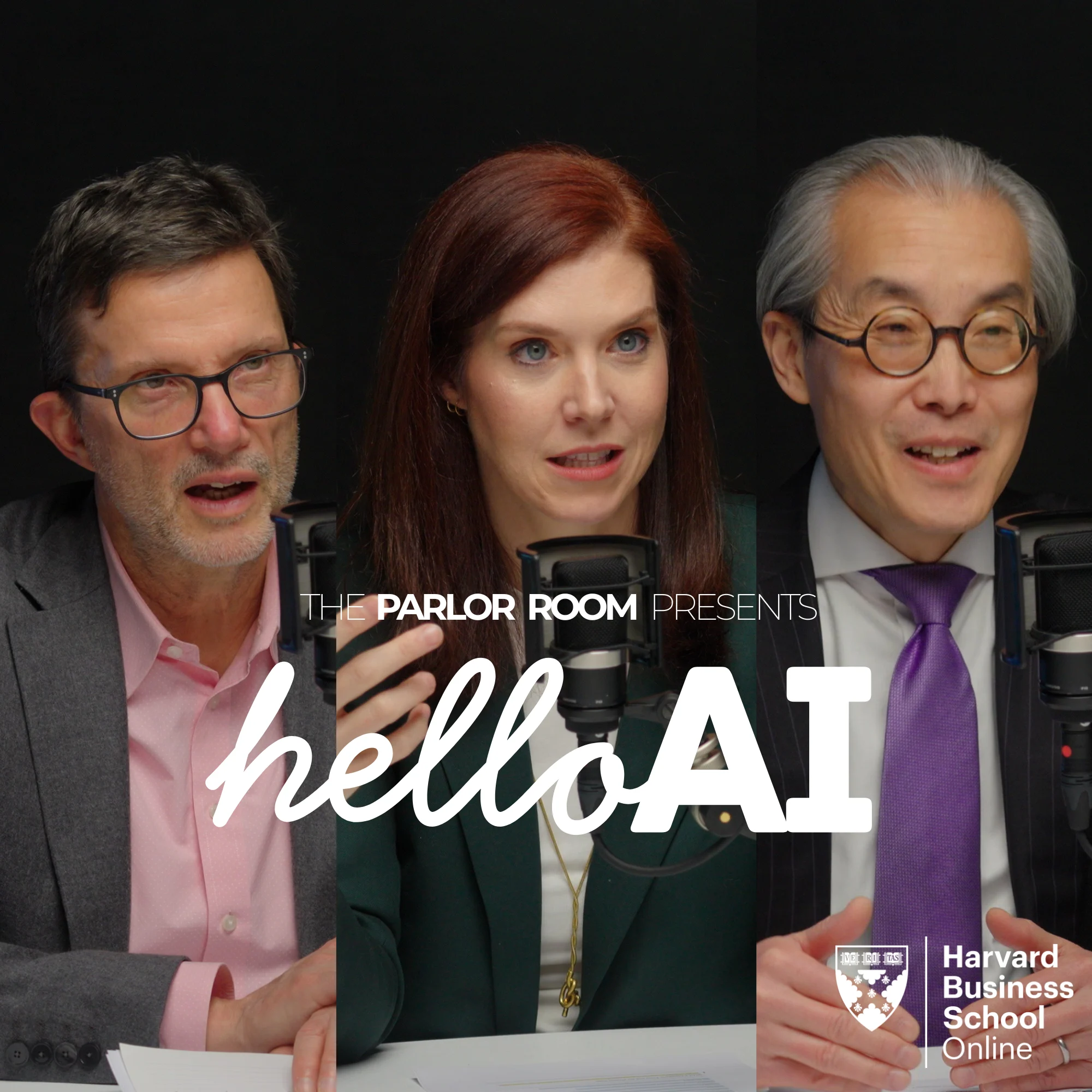
In the season three finale of The Parlor Room Presents: Hello AI, host Chris Linnane revisits his three most-played clips of the season with Harvard Business School faculty Felix Oberholzer-Gee, Christina Wallace, and Nien-hê Hsieh.
Tune in for their insights into AI's effect on jobs and productivity, the future of creative work, and whether a robot can ever truly care for us.
Resources
Catch up on previous episodes of The Parlor Room:
You can also watch The Parlor Room Presents: Hello AI on YouTube.
Transcript
Editor's Note: The following was prepared by a machine algorithm and may not perfectly reflect the interview's audio file.
Chris Linnane: Okay. So this season we asked a lot of people the same question. What happens to us when the machines get good enough? Sometimes the answer was reassuring and sometimes it wasn't. But in all honesty, I have become so tired and so bored of thinking about and talking about AI. And I think a lot of other people are feeling the same way. I don't think it's a coincidence that these three clips were the most played this season. So let's start with Felix Oberholzer-Gee. Felix gives us a more optimistic look at the future.
Felix Oberholzer-Gee: The part that is already very interesting. So now people think, oh, AI can do it much more quickly and we increase productivity. And then before you know it, we will all be out of jobs. And then you look at the data. The last three years, in the US economy, I should say, we added about three million white collar jobs. We added 7% software engineers, 10% radiologists, 20% paralegals. Exactly in the-
Chris Linnane: That's the one we hear.
Felix Oberholzer-Gee: ... in the areas we're using, oh my God, it's like, oh, catastrophe impending. And then you have to look at the data.
Chris Linnane: So that's the one specifically everyone uses as an example that will be replaced.
Felix Oberholzer-Gee: That's exactly right.
Chris Linnane: Why are we getting that wrong?
Felix Oberholzer-Gee: Yes. So maybe I'll tell you another history...
Chris Linnane: I love history lessons.
Felix Oberholzer-Gee: Okay, good. So imagine old-fashioned bank.
Chris Linnane: Yep.
Felix Oberholzer-Gee: Part of what bank dealers do, what keeps them really busy is dealing with cash.
Chris Linnane: Oh, so this isn't the old-fashioned Wild West with the thing on their head. Okay. I was imagining that bank. Sorry. Old-fashioned 1980s, '90s bank. Okay.
Felix Oberholzer-Gee: Yeah, sorry, we're not going back quite as far. They're really busy. People come in, pick up cash, the businesses bring back cash, and so on and so on. And then the ATM comes along. And everybody thinks, "Oh my God, bank tellers, doomed. No chance." And then you look at the data and over the next 20 years, we're adding a lot of bank tellers. They go, "What on earth is going on?"
And I think it's very similar to what's going on in software and so on and so on. So the story is twofold. As ATMs come along, the cost of operating branches falls. And so banks have many more branches than they used to have. And then we shift what bank tellers do from something like handing out cash, which is really not that valuable for the bank, to giving advice, to encouraging investment, and so on and so on.
So what you should imagine, when you're thinking about the employment effects, it's always two things. If AI, if any sort of technology drives down the cost, and if ultimately we pass on some of these savings to consumers, demand will rise. And so we get more business activity. That alone, I think, cushions a little bit against big employment losses. And then the second thing that's always happened in technology is that, oh, actually the productivity of individuals who use new technology goes up.
It doesn't go down. You can do more and you can do smarter, better things. Like I used to hand out cash, now I can give investment advice. And as a result, actually both the number of jobs and very often the compensation goes up. It's exactly what we see in software today. Compensation goes up very quickly. Why? Because, oh, now having a software developer who can actually use all the AI tool, you just have more output and more output is more valuable.
And in a semi-tight labor market, we can sometimes pay people less than their marginal productivity. But generally speaking, if you try to understand why is it that some people make more money than others, I think looking at differences in productivity is a good first step.
And so your expectation should be, yes, there might be jobs that are negatively affected where we use fewer people, but the bigger story for white color work in general is probably that many, many people will just be more productive. And if the labor market is maybe not super tight, but if there's good demand for these kinds of people, people will actually make more money.
Chris Linnane: This is the best news I've heard recently about this. So I'm quite happy to hear your version of things I'm fully subscribing to. Our next clip is from Christina Wallace, and I won't say much more because I left my question in this one. So you brought it up, so I want to follow up on it. I'm easily distracted by talking about the arts and things like that. So we're both from the arts world as well.
And this time we're in right now is maybe exciting, maybe upsetting with the way AI is involved. And it gets across all the worlds, the coding for sure. If you're talking about Broadway, I'm sure there are people out there right now writing Broadway songs with AI and Suno and all of those programs and different things like that. I'm trying to think, what do we do now?
There are people that are just like... I know plenty of people who are just so incredibly talented and they were born talented. And then not just that, they committed their lives to getting better and better at the thing they're doing. So they're amazing musicians, they're amazing authors, they're amazing painters, whatever it is. And we've obviously had that devalued financially.
They don't make as much money as they used to make. And I've got stories myself and stories of my friends where you're like, "Well, that song doesn't matter anymore. I can make a fake one right now." Or not a fake one, but a different one. Fake one. I'm just going to say a fake one.
Christina Wallace: Sure, a fake one.
Chris Linnane: What happens here? How do we or people who feel that they've developed that talent, then they have someone coming up hitting a couple buttons, and it feels like society is recognizing those things as equals, or maybe they can't differentiate the equals. This is not specifically business, but what do we say to the people who are feeling that right now who are just like, "Well, what was all this for? What's my special ability that I was born with or developed for now?"
Christina Wallace: Yeah. It's a great question because I have such a wide range of creative friends and their views on AI. I have some on the far extreme saying, "I'm not touching that. I'm not engaging with that entire world because it's fake and what I do is real and what the other creatives do is real. And the second I engage with that, it will use my work and build the algorithms off of that and at some point it will replace me."
And then I have on the other extreme creatives that are saying, "This is just another tool. GarageBand was a tool that made you able to make an entire song and produce things without having to have four people and a studio and all of these musicians. This is another tool that allows me to be creative, maybe to an extreme that I wouldn't have access to or coming up with entirely different modes of expression that are going to be native to this era."
So I have friends across the whole spectrum. I'm a little bit in the middle of I can see the fear and it's valid. If you think about the last big strike in Hollywood, one of the big sticking points was whether studios would be able to use AI generated extras. Because up to this point, that was one of the ways you got your leg in in that world as an actor as you're trying to network your way around, you're trying to get an agent, you're working on your craft.
Getting that day rate of a couple hundred bucks to be a stand-in in the back of some big studio film was how you paid your rent. It might be how you end up at the craft table with someone important and you start up a conversation and it gets you in the room. So it is both a sustainable piece and it gives you some sort of access. It's never a guarantee that anything is going to come, but at least it creates the possibility for luck.
And the second you recreate all of those extras with AI, because there's no great artistic intent required in having a background of a crowd, then you've cut out that entry point. In the same way that we're seeing some fear for even our MBA students who have historically been really valued by management consulting, by investment banking as that first layer of work. That work, a lot of that work can now be done by both copilots and agents.
So how do they get in and get trained, get apprenticed for the second layer and the third layer, which is where the human judgment comes in? So I think part of this is not the fear of the technology itself. It's the fear of an already very fragile creative world is going to compress even further such that only people who have independent wealth, who already have connections, who can sustain that long period it takes to get established and build a career, only they will be able to pursue this life.
So there's that piece and I fully recognize it. There's the other piece, and this is particularly within generative AI, which says everything it makes is just a remix of everything that has come before it. By definition, it has been trained on all of this thing, this data, and now it's going to pull together pieces in potentially a novel-ish way, but you're using existing materials.
So what it creates, number one, can never have intent, which is at the core of any artistic expression. Number two, it can only use what has existed to this point. And so any big shift in style, in culture, in everything... Imagine Modern Art before Picasso's Blue Era. AI could not come up with the Blue Era. It took a person who was going through experiences and tinkering with different modes of expression to suddenly say, "I'm going to have an entirely new technique and form of art," and it influences this whole shift of other artists.
AI can never go through those big creative shifts because it can't make, it can only remake. So there's still obviously a huge need for artists and creatives for that originality. There is a huge need for intent. You can't make something that is meaningful if all you're doing is remixing raw components. Artists say something with their work. Without it, it's like buying a print of a painting from Ikea.
It might be good enough to decorate the wall of your guest room, but no one's ever going to stop and spend 10 minutes staring at it and really try to take in not just the beauty, but what it's saying because it's not saying anything.
Chris Linnane: No.
Christina Wallace: So the replication of mediocre art or of things approximating art, the cost has dropped down to basically zero. And that's scary for mediocre artists. The access to building a life in it might be compressing. And that's scary for anyone who doesn't come from the resources to fund an independent life without economic concerns. But there's still clearly a role for artists who have a point of view, who have something to say, who are making and remaking the vocabulary of how we interact, setting culture, curation, taste.
We still need humans for that. We still need the judgment and truly the human condition to find the story in anything that is being made. It just is going to, in my opinion, require a pretty fundamental shift in the business model of being a creative.
Chris Linnane: So let's close on one of Nien-hê Hsieh's super thoughtful perspectives on AI. He asked a question that took me a little while to understand, and I'll paraphrase it here. Can something truly care about you if it can't choose not to care? This clip, we talk about something called Carebot, sort of like a robotic medical helper. Yeah. And going back to what you said, you said a phrase that is amazing to me, the Carebot. Is that a thing? Are people talking about Carebots?
Nien-hê Hsieh: Oh, they exist. Yeah, yeah, they exist. So in Japan, they're quite prevalent, partly because there's a growing population of elderly people and the demographics are such that they need to have robots to sort of take care of people. And so you have robots that can lift people out of bed, talk to people, things like this.
Chris Linnane: Do they accompany the Carebot with a human or is it truly like a...
Nien-hê Hsieh: I think in some tasks the Carebot is there being supervised somewhere, but yeah.
Chris Linnane: So I'm trying to think how I would respond to a Carebot. So an example I had is I remember one time I was very dehydrated. I ended up in an emergency room. They went to take my blood and I passed out. And I remember when I woke up, I was so confused, but there was a woman there who was a nurse and seeing her immediately made me feel so much better.
Because something in my mind said, she was older than me, so I was like, "I'm someone's son and you have a son. I'm going to be okay." If a Carebot blinked its robotic eyes at me, I might not have felt anything. Maybe I'd be okay, but that's the part I'm wondering. At what point do we say that's acceptable, that's good enough? Or do we say actually we deserve a little bit more, meaning the human part?
Nien-hê Hsieh: Right. I think that's the part that interests me, because there's some ways, and like I said earlier, Carebots probably are more reliable.
Chris Linnane: Yeah. They'll be there.
Nien-hê Hsieh: It's not like the person who was there next to you, had that person called in sick that day, they wouldn't have been there.
Chris Linnane: Took a phone call. Anything can happen.
Nien-hê Hsieh: The Carebot's there. So in some sense, there's a kind of reliability that you could imagine coming. There's probably a certain set of skills in terms of measuring or doing things that may be more reliable than human beings. I think the question is, do we need to feel recognized by another person? Is there something about being recognized by another person who could also choose not to recognize me? I think that is at the heart of what it means to be human at some level.
Chris Linnane: You're completely right. I know I need that. I need to feel like you choose to be here just like I choose to be here.
Nien-hê Hsieh: Right, exactly.
Chris Linnane: But I feel like the Carebot, if it came into my social setting, would be the most potentially loyal, but most boring friend I've ever had in my life who's always there. I'm like, "Oh, it's Carebot again. What's Carebot doing here?" Whatever version of it is. But I do think that that's exactly it. It's about that person doesn't need to be there or I don't need to be there, but we choose to be there.
And in my nurse scenario, she didn't... Well, she chose to be there, but that's her job to be there. But in that moment, I felt like I had safety because I was so disoriented with what was a older person that I felt like valued or empathized with my situation. I don't know if Carebot's going to give that to me in the future.
Nien-hê Hsieh: So did the person say anything to you that made you feel that or simply when you saw them?
Chris Linnane: I think she just held my hand, if I remember correctly, and just gave me that look like, "You're fine. You're fine. You're fine." And I was like, "Okay." And I think I did a lot of the work cognitively to say that she has kids. I'm sure she has nephews, nieces, whatever. And she's the age of my parents. So she must see me as something that is worth keeping safe at this moment. I might have done that all myself. And she might have just been like, "Oh yeah, all right, kid, figure out. I can't wait for lunch." I don't know.
Nien-hê Hsieh: That's possible to do, right?
Chris Linnane: Yeah. But I did something about that connection, but I don't know if that's going to... Maybe we'll get there, but I don't know if robots will ever have that kind of feeling for people. And if they do, is that bad that we've now switched over to be okay with those kind of things? There are people I'm sure who are okay with it already. I'm not.
Nien-hê Hsieh: Right. Well, it's tricky. So we can go to two extremes. Do you have a pet?
Chris Linnane: I've got pets, yeah.
Nien-hê Hsieh: What kind of pets do you have?
Chris Linnane: I've got a dog, I've got a cat, and my oldest daughter has a rabbit, which I wish we never got.
Nien-hê Hsieh: No, why not? Because there's only one of them or what? They're going to become many?
Chris Linnane: No, there's one of them, but it's such a pain. I suggest if you're thinking about getting a rabbit, think long and hard about having a rabbit.
Nien-hê Hsieh: How would you describe your dog? Is your dog loyal to you?
Chris Linnane: Oh, very. Yeah. Yeah.
Nien-hê Hsieh: Could your dog choose otherwise?
Chris Linnane: No. Well, my wife and I joke about this all the time because he seems so happy that we think it wouldn't have to be us. I feel like he could just go to any house, and if they showed him affection, he'd be happy there too.
Nien-hê Hsieh: But you love your dog, right?
Chris Linnane: Yes, I do. Yeah.
Nien-hê Hsieh: And do you feel like your dog kind of loves you?
Chris Linnane: I think so, yeah.
Nien-hê Hsieh: So one thing I've often wondered about is like, so is that different from the Carebot?
Chris Linnane: Oh, interesting. Oh man, that's a very good point because my dog is not smart.
Nien-hê Hsieh: Probably smarter than you think.
Chris Linnane: Yeah, maybe, maybe. You're right. But his function is to be there hanging out with us. And the Carebot's function is to be there doing whatever you need it to do.
Nien-hê Hsieh: Right. But somehow the Carebot also feels different from the dog, right?
Chris Linnane: Yeah, because the dog, I feel like... I don't know. Would it walk away from me and be like, "I'm disinterested?" I'm sure they get tired of us, but I don't know. That's interesting. I'm thinking about human to robot. I'm not thinking about human to dog to robot to human to dog. That's overwhelming me a little bit. Is a dog only as good as a robot?
Nien-hê Hsieh: Well, so it's an interesting question. Part of it is I think that it's part of what we compare it to. We're comparing the dog to the dog.
Chris Linnane: Yeah.
Nien-hê Hsieh: Right? We're comparing Carebot to human beings. And part of, I think, a really interesting question is how we choose to design these Carebots, let's go with Carebots for the moment, to occupy that role. And I think there's a tendency either to try to make things more and more human-like, which goes into the problem that we discussed before about living with an approximation that then either doesn't have what we're looking for in terms of that recognition or may even, in some sense, bring us to a point where we're completely comfortable without that recognition and simply being in our own world.
But maybe the thing to do is to develop these robots in a way that actually they're not meant to be like humans and maybe more like cartoons or animation or like dog. And maybe that's actually the way to do it. So they're not actually meant to sort of...
Chris Linnane: But if you did create a separate species that's called the robot and it served its parallel purpose to a dog or a cat or whatever, it doesn't feel like it's a competition with humans. It feels like a tool. It's like a dog, but a dog has a heart and feelings, but it's a tool and it's more like your vacuum times 7,000 kind of thing. And that might feel safer than look how realistic.
Nien-hê Hsieh: I think that's right. I think that's right. So I actually think it's a mistake to try to make them more human-like, if that makes sense.
Chris Linnane: Oh yeah, because that comes down to when would we know if it's a human or a robot later? And if we do it the way you're talking about it, it'll always be very clear.
Nien-hê Hsieh: Right. So it'd be like the opposite of Westworld.
Chris Linnane: Oh, the opposite of Westworld would be great. Season one, I really like season one. I go to season two, I got turned inside out. I didn't know what was going on. That's it. Season three of The Parlor Room is in the books. This season we didn't have a set or a crew or even an editor, but we still released 16 or 17 great episodes.
And I want to thank everyone at Harvard Business School who helped get the show out, especially Kiley Reitano, Matt Keller, and Lauren Landry. If you like the show, please check out the other episodes or the other seasons. And if you could, take a moment to like or follow this show wherever you get your podcasts. It would help me out a lot and I'd really appreciate it. Thank you for watching or listening to season three.