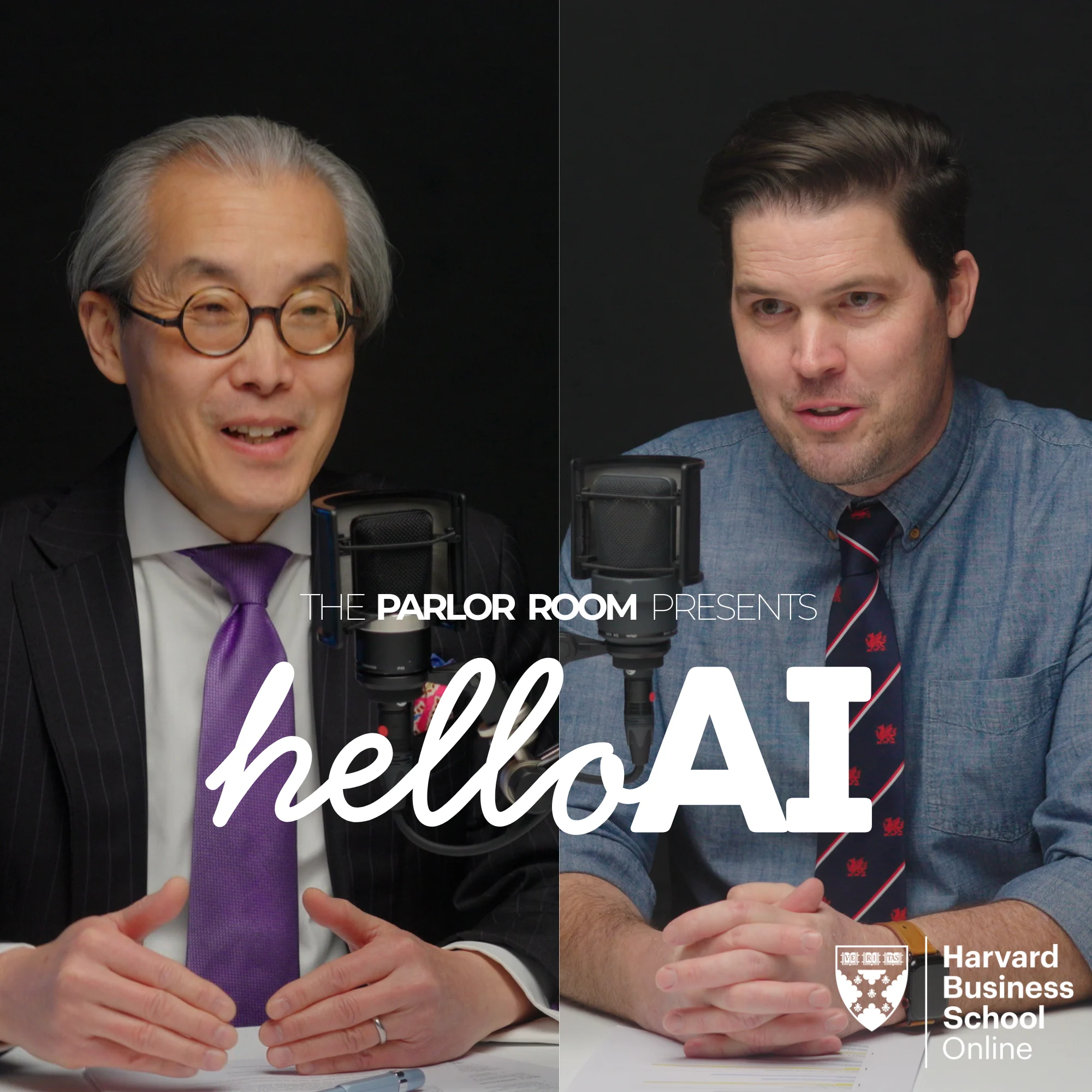
In this episode of The Parlor Room Presents: Hello AI, host and Harvard Business School Online Creative Director Chris Linnane speaks with HBS Professor Nien-hê Hsieh about the ethical challenges of artificial intelligence. Hsieh discusses AI's impact on work, accountability, and human connection, and explains why responsible leadership and human judgment are critical as organizations adopt AI.
Resources
Learn more from Hsieh in his HBS Online course: Leadership, Ethics, and Corporate Accountability.
Catch up on previous episodes of The Parlor Room, featuring Hsieh:
Compilation Episode (Part 2): Early Career Advice for Building AI and Human Skills
Compilation Episode (Part 3): Mid-Career Strategies for Thriving in an AI-Driven Workplace
You can also watch The Parlor Room Presents: Hello AI on YouTube.
Transcript
Editor's Note: The following was prepared by a machine algorithm and may not perfectly reflect the interview's audio file.
Nien-hê Hsieh: I don't know if you want to necessarily go there, but I do think there is a broader question of, ultimately, who owns the robots.
Chris Linnane: Oh boy. I do want to go there.
Voiceover: Nien-hê Hsieh is a Professor of Business Administration at Harvard Business School.
Nien-hê Hsieh: And I sort of worry that AI is moving at a speed in the same kind of way that we should really learn the lessons from what happened with social media.
Voiceover: Ownership is easy to claim and hard to prove.
Nien-hê Hsieh: So decency, I think, involves a few important features as a kind of guiding ethos.
Voiceover: Ethics without accountability is just a slogan.
Nien-hê Hsieh: The more we assign responsibility for the deployment and the decisions that are made, you actually probably will see better deployment of the artificial intelligence because now there's actually somebody who, in some sense, owns it.
Voiceover: Welcome to The Parlor Room Presents: Hello AI.
Chris Linnane: Let's start with a positive angle. If you step back from your research, from your teaching, what excites you right now—the moment we're in between humans and AI?
Nien-hê Hsieh: So the first thing is maybe we are finally at the moment where the things that are routine, boring, dangerous about work can be eliminated and done by machines. Because if you think about it, every generation of technological progress has promised that we will be freed from drudgery, for example. You go back to Oscar Wilde, back in the 1850s. He was talking about how machines would liberate us from sort of drudgery and allow us to pursue the arts and do the kinds of things that we really wanted to do.
But if you think about it, that really hasn't come to pass. If you think about kitchen appliances, laundry machines, right? Those are supposed to take away some of the drudgery and time that people spend doing those tasks, but apparently, people still spend the same amount of time doing a lot of household work. So maybe we're at a moment where this technological development will allow people to be freed up to do the kinds of things that they would want to do in their creative time.
So that's sort of one thing that could be good. I think something else that's interesting is that artificial intelligence may allow us to do things a lot better. So what I mean by that are things, like drug discovery, is one area where there's a lot of promise, for example. And so that's another thing that's sort of exciting.
Another thing that I think is exciting is that AI can do things differently from how we do things. So here I have in mind an example from a number of years ago, which is AlphaGo. So I don't know if you're familiar with AlphaGo or not.
Chris Linnane: No.
Nien-hê Hsieh: Okay. So, AlphaGo is a program that was designed to play Go, the game Go. And many people thought that the game Go, because of the number of possibilities on the board, would make it impossible to have a machine do the same way that a machine could be at a human at chess.
But AlphaGo basically learned how to play chess, sorry, play Go, and essentially beat some of the great world masters at Go. But what was interesting was that some of these world masters actually started training themselves with AlphaGo, and what they learned was that AlphaGo was making moves that nobody had ever encountered before in the game of Go.
So, there's a way in which artificial intelligence can approach things that we do in a way that's different that actually could be interesting to learn from. And I guess if I'm allowed a moment of sort of fantasy, I suppose the great thing would be to be like Tony Stark and have a Jarvis, and that'd be pretty cool.
Chris Linnane: Yeah. Now we often hear that AI, kind of, and the large language models and all these things are based off of things that already exist, and it's reconfiguring, taking pieces, putting together. So in that AlphaGo example, how was it doing things that people hadn't thought of before?
Nien-hê Hsieh: So that's a great question. I think part of it was that it actually trained against itself, and so that's sort of one way in which it might have learned new things. Another way is that some models also aren't just purely engaged in pattern recognition, right, but they're actually engaged in a kind of form of basic reasoning, as it were. So it's not just simply based on a prediction model, sort of the parrots and the machined kind of LLM, but actually thinking in terms of sort of patterns and then learning from that to sort of think more abstractly.
Chris Linnane: On the flip side, what are the things that are going on right now that maybe concern you about humans and AI in the workforce?
Nien-hê Hsieh: How much time do we have on our podcast, Chris?
Chris Linnane: We have hours and hours. Go for it. Yeah, let me know. I mean, I feel that more than I feel the positive. So what are you thinking?
Nien-hê Hsieh: At a very basic level, one could think of artificial intelligence as a kind of multiplier, both in terms of the speed at which things happen, the scale at which they happen, and also the scope in terms of our lives. So part of me worries that any kind of problem we already have in the world will basically be exacerbated by the application of artificial intelligence. So here are some examples. So think about, for example, not to sort of make things worse.
Chris Linnane: Oh, I've got to take a deep breath before we get this. Go ahead.
Nien-hê Hsieh: But actually, that's all the time we need. But if you think about, for example, something like social media, the malicious use of social media, say, for example, like misinformation, or that's just compounded by AI because AI is very good at producing misinformation or deep fakes or the kinds of things that already we worry about can be done much more quickly and more effectively. So that's sort of an example there.
Or if we think about the environment. AI uses a lot of energy, and so the more that we use AI, in some sense, we're just multiplying the use of energy that sort of raises challenges there. And you sort of see the whole thing about data centers, the need for water. So again, just as we grow, that problem is compounded as well. Or if we think about inequality, both in terms of, say, loss of jobs, but also in terms of concentration of ownership of the benefits of AI, that kind of inequality is likely to grow.
And one that we don't think about as much, I think, is actually the question of linguistic access, right? So you mentioned earlier that LLMs are basically trained on what exists, but they're also trained on a few languages. So they work really well for those languages, but if one doesn't speak one of those languages, the access to LLMs is really not there. Or similarly, it'll then probably just sort of concentrate people on focusing on a few languages, and other languages that are sort of left behind will increasingly be left behind because the time and energy that would be spent to develop an LLM for those languages isn't really sort of there. So that's another kind of inequality that we don't talk about much, but that'll also be compounded by the growth of AI.
And then I think there are probably some problems that are maybe specific to AI itself as a technology. So not just sort of compounding the kinds of problems that we already have. Something that I know you and I have talked about before is that because AI is such a good, or approximation, of engaging with another human being, I think for me, the biggest worry that I have is that we'll sort of forget why we actually want to engage with another human being as opposed to sort of a good approximation of one.
Chris Linnane: Wow. That one is, I think, the one that gets me the most. I'd like to talk about two quick things with that. I'll go back to that point you just made about the human part, but the usage of electricity to run this whole thing. A couple of years ago, I was a person who told myself I would never own an electric car, just because, I don't know. I think I like old things a lot, but I ended up getting an electric car, because the incentives were great, and it was a great deal, and now I feel like I'm just contributing to this giant environmental suck of electricity that's going on right now.
How bad is it? Like, what is this huge wave that's exploding across all the usage, especially in AI? How is that going to affect us, and what should we be thinking about from almost like an ethical or a moral perspective?
Nien-hê Hsieh: You mean in terms of the energy use or just more generally?
Chris Linnane: The energy use, I think.
Nien-hê Hsieh: So I don't have the latest numbers with me, but I've seen some examples where the energy use owing to the use of AI, it's not insignificant. I mean, it's like adding 10 percent, 20 percent, or something to the kind of energy that we already use. And the more that we use it, that sort of compounds the problem. Look, I think there are two ways to think about the energy issue.
One is who actually has access to the energy? So again, to my earlier point about the kind of inequality that we might be seeing, for example, in which large language models are developed on, similarly, if we look at where in the world is their energy to power artificial intelligence, it's already in the places that are relatively better off than places that aren't. So this is another example of how that kind of inequality will get compounded, and to just sort of make things worse in that sense, right? So who benefits from it?
But then there's a question of, I guess, the pollution or sort of the carbon aspect of things, and that unfortunately will continue to sort of affect everybody in a way that's different from who benefits from it.
Chris Linnane: The second point you brought up, too, is about the relationship aspect and the approximation of a human, and is that going to become acceptable is terrifying to me because I remember when a movie called Her came out with Joaquin Phoenix. I never saw it because, to me, it was at the time so far-fetched and unsettling; I had no interest in seeing something like that. But I think if it came out today, it would almost feel like old news, and obviously, there are already lots of people who have developed a significant relationship with something artificial. Based on your research and what you're working on, that kind of scenario where people are starting to opt for the artificial over the actual, is that growing, or is that just like hype that's happening?
Nien-hê Hsieh: So I think it's growing, but I think we should be clear that it's not necessarily all bad. So I think that for some people, for various reasons, this actually may be easier, and better, and in some sense, the alternative for some people is actually no human contact.
Chris Linnane: Oh, okay.
Nien-hê Hsieh: Yeah. And so, for some people, studies show that this actually can be beneficial in a certain way. I think the concern for me, and maybe this is your point, is that because it's what we should...for some people may creep into it, and it just becomes a way to do things that we don't sort of think about. I think for me, the real concern is not just the engagement with a machine in a way that we sort of then forget about the value of what it means to engage with a human being. I think that's a large part of it.
The part that worries me a little bit is, well, not all of it worries me, but the part that is a little bit concerning is the way in which that interaction is tailored to us in a way that it wouldn't be when we engage with another human being. And insofar as we engage in that kind of a discussion, we become more and more sort of within our own world, and we don't actually have to confront or engage in friction with other people. So that's the part that is, I think, in addition to all the other things we might talk about, about what it is to sort of, why would want to engage with people and not, but that's the part that I think worries me the most.
Chris Linnane: Yeah. So we essentially could become very fragile, more fragile. We're able to accomplish more, maybe, from a business perspective or a creative perspective, but internally we've become so insulated and isolated that we're maybe more fragile at the same time.
Nien-hê Hsieh: More fragile or more fragile, maybe even in some sense, we might even forget. So it's not just the fragility of sort of being able to engage with another person. I think it's also the question of recognizing that there are other values or views or things other than the world we have to deal with.
Chris Linnane: It feels like when you have a relationship with someone or family, anybody, it's hard to lose that relationship, whether it fades away or whether death or geography or whatever, but it's terrifying now to think that these relationships are then these new versions of these relationships might have the same power or feeling, but they're completely dependent on software and companies. So someone rolls out a new version of this thing, and you've now lost—that version died. I mean, that's terrifying to think that people are becoming dependent or potentially dependent on these things. Scares the heck out of me.
Nien-hê Hsieh: Yeah, that's true. I think it is scary. The dependence upon other people for the relationship is one thing, but I think also what is scary is that, if we're thinking about it being provided by a company, it's another kind of a commodity, right? It's another kind of product or a service, and how do we enter into a relationship with a company or in a product or service is that we basically opt in because we want to purchase the product or the service, right?
So, already we go in with a kind of view of what we're looking for and already making that kind of choice based upon certain things about ourselves that we want to see reflected in the other person. But to your point about relationships, part of what makes relationships real is that we can't just purchase or enter into a relationship fully customized to what we want, and that's partly how we learn to live with other people.
If you think about our sick family, some of the most important relationships in our lives, we had zero choice and learning, for some people it's very hard, because it's a very dysfunctional relationship into which they enter, and granted, they may want to leave it, and understandably so. But I think for the vast majority of us, we have to learn how to navigate and adjust and sort of become and grow to be different people precisely because of that friction and precisely because of the fact that we didn't choose into that relationship.
Similarly, I think part of what makes relationships so important, and meaningful, and valuable is the possibility of loss. Either because people may pass away, either because people may choose to leave the relationship, and that possibility of loss, or the sense of somebody leaving us, is also partly what makes that relationship valuable, right? Because that person is now there and they're not gone, or because that person has chosen to love me and be with me, their choice. Their recognition of me is what makes that relationship valuable. But if I now approach that relationship as a customer who's buying a service, I can always replace it, and they can't choose to leave me.
But the fact that we...so then the question, so then what are we really sort of getting out of these relationships if we can always replace them or if we can buy one that is always there for us, it heightens a kind of narcissism in a way that it can be, I think, worrisome.
Chris Linnane: Yeah. I'm there. I'm worried. I'm worried across the board. Okay, so if we shift gears and talk more about the health of business, we talk a lot about AI is creating millions of jobs, and then we're hearing AI is replacing tons of jobs. If we're looking at this through that lens, through like the jobs number lens, are we missing out on bigger questions?
Nien-hê Hsieh: Well, I'm glad you mentioned the part about job creation because people often don't focus on that part, right? We sort of focus on the job loss and forget the part that actually, new jobs are being created. I think some estimates say that in the short run, at least, on net, we will actually have more jobs as a result of the growth of AI.
Chris Linnane: That would be wonderful.
Nien-hê Hsieh: It'll be in certain areas, right? So interestingly, it'll be in things like data science, and then also people were sort of, as you mentioned before, providing the energy and hardware and things like that. And then probably it'll also lead to, unfortunately, sort of loss of certain kinds of other jobs too. So that's sort of one thing there, but on net it looks like maybe it might be positive, assuming people can then access those new jobs. I'm glad you mentioned that because we shouldn't forget that part. So it's not all doom and gloom, but I think it does miss a few things.
One is I think in focusing on the job loss owing to being replaced by AI, what it does is it focuses on those parts of jobs that actually aren't distinctly human. So we keep focusing on, "Okay, what are we losing in this job because of the replacement with AI," and we sort of think, "Okay, then how can we sort of address that problem?" I think it sort of tends to focus our attention on, okay, well the parts of jobs that are replaceable by AI and not the things in jobs that actually set us apart from AI, which are the kinds of things that we'd actually want to focus on if you can imagine trying to help people address a world in which there will be more and more AI in the context of work.
So that's sort of one thing that we move, and then that sort of brings us back to the issue of, well then, why is it that you would want to have people at work in your workplace, in your business, in your company, and not AI, even if AI could actually do the task that we narrowly define just as well. And I think that's the part that we sort of tend to overlook, is like, well, what is it actually about having people doing the work that matters?
Chris Linnane: That's a fascinating way to look at this because when I hear these reports come out and they're kind of all these forecasts more than anything, they're not really reports, I guess they're mostly forecasted this more. There are some reports. I feel like I'm riding this wave of good news, bad news, good news, bad news, good news, bad news, and it's exhausting. And your perspective on or what you're hoping happens that we do start creating some new jobs is one of the more positive things I'm hearing because I often hear the opposite, and I think people are just ready to accept the doom feeling.
In the situation we're all in right now, what kind of things should we be kind of watching ourselves about our positions, our jobs, to indicate whether there are things we're doing that could be replaced, or are there things that we should skill up on to make ourselves more valuable and differentiate ourselves?
Nien-hê Hsieh: So the question I often ask is, assuming that the basic task could be performed by a machine or artificial intelligence and get the basic job done, are there still reasons you would want to have a human being instead? And part of it is actually how you define the job, right? Take, for example, something like physician assistants or care workers in home care. There are lots of ways in which robots can actually make things easier and say, for example, lifting up a human being and putting them in bed. It doesn't risk the kind of physical harm that might come to the care worker. There's a sense in which there's a reliability for the person who's being cared for. So in some sense, the basic task could be done. The question is, is there any reason you'd still want to have a human being doing this? And that sort of takes you slightly beyond what we understand the basic tasks to be.
And so if the basic task involves elements of that human relationship, then that's the part that you'd want to focus on. So why might a person want to have a human person caring for them as opposed to a carebot or something like that? And for some people, I think there's this sense of being cared for, literally being cared for, not in terms of having the basic sort of task done, but having another person there who recognizes them, who sees them, who views them as another human being in that context, not taking pity on them, but being there to care for them. And that is something I suppose you could create a robot that could say things and act in ways that would suggest that they care for you. But the real question is, does a robot really care for me? And maybe I could experience it as care, right?
It's just true that, look, it's true also that they're human beings who are being cared for who don't experience it as care. I look at, I hope my daughters aren't listening, but sometimes I do things that I think, "Hey, this is for your own good." My daughter does not experience it that way. She does not experience me as caring for her in that immediate context, and yet I do. So clearly, there's also that part about how the other person receives it. But I think part of what care is, this goes back to our earlier point, is that part of what makes care possible is the fact that I also could choose not to care for somebody, right?
That's what makes it care. And so can the carebot really choose not to care for me? I'm not sure, but that's partly some...so to the extent that we could imagine and find and identify those parts of jobs where it is that it's important to have another person there, those are the things we should focus on. We can talk about this some more, but I think another thing that we could focus on is taking on more responsibility, right? Actually making yourself more accountable. A lot of us sort of want to shirk responsibility because it's kind of a scary thing, but actually that's precisely what we need to focus on in this world because it's people who are going to be held accountable and the more that you can be held accountable for and the more responsibility you embrace, I think that's actually an also important response to some of these things as well.
Chris Linnane: Yeah. And going back to what you said, you said a phrase that is amazing to me, the carebot. Is that a thing? Are people talking about carebots?
Nien-hê Hsieh: Oh, they exist. Yeah. Yeah. Yeah. They exist. So in Japan, they're quite prevalent, partly because there's a growing population of elderly people and the demographics are such that they need to have robots to sort of take care of people. And so you have robots that can lift people out of bed, talk to people, things like this.
Chris Linnane: Do they accompany the carebot with a human, or is it truly like a—
Nien-hê Hsieh: I think in some tasks, the carebot is there being supervised somewhere, but yeah.
Chris Linnane: So I'm trying to think how I would respond to a carebot. So, an example I had is I remember one time I was very dehydrated. I ended up in an emergency room. They went to take my blood, and I passed out. And I remember when I woke up, I was so confused, but there was a woman there who was a nurse, and she was just, seeing her immediately made me feel so much better because something in my mind said she was older than me, so I was like, " I'm someone's son, and you have a son, I'm going to be okay." If a carebot blinked its robotic eyes at me, I might not have felt anything. Maybe I'd be okay, but that's the part I'm wondering. At what point do we say that's acceptable, that's good enough? Or do we say, actually, we deserve a little bit more, meaning like the human part.
Nien-hê Hsieh: Right. I think that's the part that interests me because there are some ways right in with, like I said earlier, carebots probably are more reliable. They'll be there. It's not like the person who was there next to you had that person called in sick that day, they wouldn't have been there, but—
Chris Linnane: Took a phone call, anything could happen.
Nien-hê Hsieh: The carebot's there. So in some sense, there's a kind of reliability that you could imagine coming— there's probably a certain set of skills in terms of measuring or doing things that may be more reliable than human beings. I think the question is: Do we need to feel recognized by another person? Is there something about being recognized by another person who could also choose not to recognize me? I think that is sort of at the heart of what it means to be human at some level.
Chris Linnane: You're completely right. I know I need that. I need to feel like you choose to be here, just like I choose to be here.
Nien-hê Hsieh: Right, exactly.
Chris Linnane: But I feel like the carebot, if it came into my social setting, would be like the most potentially loyal but most boring friend I've ever had in my life who's always there. I'm like, "Oh, it's carebot again. And what's carebot doing here?" But whatever version of it is. But I do think that that's exactly it. It's about that person doesn't need to be there or I don't need to be there, but we choose to be there.
And in my nurse scenario, she didn't...well, she chose to be there, but that's her job to be there. But in that moment, I felt like I had safety because I was so disoriented with what was an older person that I felt like valued or empathized with my situation. I don't know if carebot's going to give that to me in the future.
Nien-hê Hsieh: So did the person say anything to you that made you feel that, or simply when you saw them?
Chris Linnane: I think she just kind of held my hand, if I remember correctly, and just gave me that look like, "You're fine, you're fine, you're fine." And I was like, "Okay." And I think I did a lot of the work cognitively to say that, "She has kids. I'm sure she has nephews, nieces, whatever, and she's the age of my parents, so she must see me as something that is worth keeping safe at this moment." I might have done that all myself, and she might have just been like, "Oh yeah, all right, kid figured out. I can't wait for lunch."
Nien-hê Hsieh: It's possible, too, right?
Chris Linnane: Yeah. But I did something about that connection, but I don't know if that's going to, maybe we'll get there, but I don't know if robots will ever have that kind of feeling for people. And if they do, is that bad that we've now switched over to be okay with those kinds of things? There are people, I'm sure, who are okay with it already. I'm not.
Nien-hê Hsieh: Right. Well, it's tricky, right? So we can go to two extremes. Do you have a pet?
Chris Linnane: I've got pets, yeah.
Nien-hê Hsieh: What kind of pets do you have?
Chris Linnane: I've got a dog, I've got a cat, and my oldest daughter has a rabbit, which I wish we never got.
Nien-hê Hsieh: No, why, because there's only one of them, or what they're going to become many?
Chris Linnane: No, there's one of them, but it's such a pain. I suggest, if you're thinking about getting a rabbit, think long and hard about having a rabbit.
Nien-hê Hsieh: Yeah. How would you describe your dog? Is your dog loyal to you?
Chris Linnane: Oh, very. Yeah. Yeah.
Nien-hê Hsieh: Could your dog choose otherwise?
Chris Linnane: No. Well, my wife and I joke about this all the time because he seems so happy that we think it wouldn't have to be us. I feel like he could just go to any house, and if they showed him affection, he'd be happy there, too.
Nien-hê Hsieh: But you love your dog, right?
Chris Linnane: Yes, I do. Yeah.
Nien-hê Hsieh: And do you feel like your dog kind of loves you?
Chris Linnane: I think so, yeah.
Nien-hê Hsieh: So one thing I've often wondered about is like, so is that different from like the carebot?
Chris Linnane: Oh, interesting. Oh man, that's a very good point because my dog is not smart.
Nien-hê Hsieh: Probably smarter than you think.
Chris Linnane: Yeah, maybe, maybe. You're right, but his function is to be there hanging out with us, and the carebot's function is to be there doing whatever you need it to do.
Nien-hê Hsieh: Right. But somehow the carebot also feels different from the dog, right?
Chris Linnane: Yeah, because the dog, I feel like, I don't know, would it walk away from me and be like, "I'm disinterested?" I'm sure they get tired of us, but I don't know. That's interesting. I'm thinking about human to robot. I'm not thinking about human to dog to robot to human to dog. That's overwhelming me a little bit. Is a dog only as good as a robot?
Nien-hê Hsieh: Well, so it's an interesting question. Part of it is, I think, that it's part of what we compare it to. We're comparing the dog to the dog. We're comparing carebots to human beings.
And part of, I think a really interesting question is, how we choose to design these carebots. Let's go with carebots for the moment to occupy that role. I think there's sort of a tendency either to try to make things more and more human-like, which goes into the problem that we discussed before about living with an approximation that sort of then either doesn't have what we're looking for in terms of that recognition or may even in some sense bring us to a point where we're completely comfortable without that recognition and simply being in our own world. But maybe the thing to do is to sort of develop these robots in a way that actually they're not meant to be like humans, and maybe more like cartoons or animation or like a doll. And maybe that's actually the way to do it to sort of create a... so they're not actually meant to sort of create that kind of experience. That's sort of one thought. How is your cat?
Chris Linnane: My cat is independent, very independent. Still a good cat, but not interested in us mostly.
Nien-hê Hsieh: But do you feel excited when your cat actually then pays attention to you?
Chris Linnane: I do sometimes, yeah. Yeah. I'm happy for that to have that cat. It's interesting, though, you're making me think of this a different way because it feels like the race is always how human can this robot become? How human can this AI behave? That that's what feels potentially threatening and unsettling. But if you did create a separate species that's called the robot and it served its parallel purpose to a dog or a cat or whatever, it doesn't feel like it's a competition with humans. It feels like a tool. It's like a dog, but a dog has a heart and feelings, but it's a tool, and it's more like your vacuum times 7,000 kind of thing, and that might feel safer than look how realistic that is.
Nien-hê Hsieh: I think that's right. I think that's right. So I actually think it's a mistake to try to sort of make them more human-like, if that makes sense.
Chris Linnane: Oh yeah. Because that comes down to when would we know if it's a human or a robot later, and if we do it the way you're talking about it, it'll always be very clear.
Nien-hê Hsieh: Right. So it'd be like the opposite of Westworld.
Chris Linnane: Oh, the opposite of Westworld would be great. Season one, I really like season one. I got to season two, I got turned inside out. I didn't know what was going on. When people say that AI is going to augment human work, what assumptions are baked into that statement?
Nien-hê Hsieh: Well, one assumption is that people will actually be comfortable working with AI, and that's a number of different ways in which we could imagine that. So one is the adoption. So one of our colleagues here at Harvard Business School has studied different rates of adoption of AI use at work based upon gender and found actually quite a stark difference in terms of that adoption between men and women.
Chris Linnane: Yeah. What is it? That's interesting.
Nien-hê Hsieh: Yeah. So women tend to be less engaged in the use of AI at their work despite equal kinds of encouragement that might occur there between men and female employees. So one question is, are people willing to engage with AI? And so there's number of reasons one may or may not, but I think that's one of the questions that we have to assume is that people actually feel comfortable working with AI if it's going to be actually augmenting people's work and you wouldn't want it to then basically be used by some people and not others in a way that basically then replicates other kinds of inequalities in the workplace. So that's sort of one kind of hidden assumption there.
I think another assumption is that in the long run, by augmenting people's work, we're actually not training AI to replace people. You could imagine sort of this great training experiment, where by augmenting people's work, it's actually simply learning how to do people's work.
Chris Linnane: Which is kind of what everyone feels right now is happening, but maybe not.
Nien-hê Hsieh: Right. So then, in the long run, it's not really augmenting people's work. So is it a question of time horizon that we're simply talking about, or is it really the case that what we're doing is we're sort of going back to our earlier point, what is it that people do that is different in kind from what the robots or machines can do, and then are we augmenting it in that kind of a way?
Chris Linnane: That's interesting because when I always think about there's only so much work, and this is just, I haven't thought too hard about it. There's only so much work that can be done of value that people are willing to pay to have done. And as we eliminate like the redundant, simple tasks, the pool of overall value has to get smaller.
I would think, so I've eliminated 30 percent of my tasks anymore, but I can expect to only make 70 percent of what I made before. That's my thinking, but it sounds like that smaller thinking because you're saying it's expanding beyond the 100 percent, maybe. So you let 30 go to them, you stick up the 70, but then you're going to go create another 30 on top of that to get the whole at 100 again. Is that what we're saying?
Nien-hê Hsieh: That's one possibility. Ideally, that would be the case, but you're right. I think if you look at the whole population, the question is, is there going to be enough work that humans are doing for which people will be willing to pay? And I think there's a whole class of work that you can imagine people being willing to do, maybe even freely in some sense, that people may or may not pay for, but that all depends upon the question of to what extent are people dependent upon their labor for their income. I don't know if you want to necessarily go there, but I do think there is a broader question of ultimately who owns the robots.
Chris Linnane: Oh boy, I do want to go there.
Nien-hê Hsieh: And Richard Freeman, an economist here at Harvard, has said, "Who should own the robots?" And this whole question of worker displacement and loss of jobs would not be as serious if workers were also owning a share of the robots.
Chris Linnane: Yeah, because right now it's like five CEOs who own the robots.
Nien-hê Hsieh: Well, and a lot of our pension plans. But no, think about it. So, to your earlier example, okay, so 30 percent is now being done by the robot, 70 percent is being done by me. If there's no extra 30 percent for me to do, but if I actually benefit from some of that 30 percent that's being done by the robot because I own a share in the robot, then actually it isn't a cost to me in terms of my earning pension.
Chris Linnane: You become whole again.
Nien-hê Hsieh: Right, exactly. That's right.
Chris Linnane: So what does that look like, owning it?
Nien-hê Hsieh: Well, you buy shares in Microsoft.
Chris Linnane: y Yeah, that's my only way in, right?
Nien-hê Hsieh: But I know I'm actually, I have joking, but I think there is something to be said for that idea of, so what is it that you would do? So I think one example was, I think, Bill Gates introduced very early on the idea of putting a tax on robots. So if you had a tax on robots, that would actually sort of cover in some sense the social cost of displacement that's being put into place by the robot. And so that tax that then could go to the government that could then be used to sort of redistribute income. That's sort of one possibility that people talk about. Other people talk about basic income as a version of that, as sort of a kind of a basic income that comes from that.
But I think more directly to your point, there probably is a case to be made for having people participate directly in the companies that either produce and own them, or if you're at work, for example, you could imagine if the place of employment itself, so you don't have to directly own the robot, but if robots are being used at a company and employees were involved in part of the ownership of the company, they are too then actually benefit from the use of that robot, if that makes sense.
And so that's another part of the work that we've been doing here at Harvard in the ownership project is sort of looking at alternative ways of structuring ownership of companies, and are there ways to involve more people in the ownership? That's another way to sort of indirectly get at the question of owning a robot.
Chris Linnane: Do you think the people who are running these companies or have a say in these massive corporations, do they have a moral responsibility to try to make this happen for people, or—
Nien-hê Hsieh: I think every company and people who are working in the company, and all of us in general, have a responsibility to try to anticipate and think about and address the potential externalities of our actions. And if you think about job displacement as a kind of externality at a society-wide level, then yes, I think companies do have a responsibility to try to think a little bit about, well, what is it that we might do to sort of help address that problem? Especially if it's not the case that...I think in the normal situation we say, "Well, job displacement happens, retraining happens, people can switch and find new kinds of work." That's possible, but if in the scenario that we're talking about, that's harder to do. I think there is a kind of responsibility to think about the broader impact. Just as we think about a company should think about their impact on the environment, for example.
So I don't think it's any different from that exactly. What makes this slightly different, I think, is that the direction of how these technologies are going to be developed, right? So it's not just an externality in the sense of job displacement or things like that, but I think we need to have a conversation about the direction in which this is going. And that's why you see companies like OpenAI initially and Anthropic now, they've tried to set up a governance structure that has a slightly broader sort of stakeholder component to it in terms of thinking about how the company is run in sort of its direction.
Chris Linnane: I don't know how to say this without sounding too negative, but do you think it's okay for me to have almost no trust in these corporations?
Nien-hê Hsieh: In other words, your skepticism of their concern would be justified. Is that your point?
Chris Linnane: Yeah. I question motives and I feel like there's so much that could be done right now that's not being done and that when you overlap this new technology and what we're talking about right now, it feels like we're miles away from the ones who have this power in the situation really helping where they can help as opposed to just like their motivation is not us, I don't think.
Nien-hê Hsieh: So how would you characterize their motivation then?
Chris Linnane: To make as much money as they can, as fast as they can.
Nien-hê Hsieh: So that motivation to make money is there for all businesses, I think, right? And obviously, part of what's going on in this situation is it's not just the motivation to make money, but there's the competition at stake to sort of really, that's quite a competitive space, and so I think it makes it more complicated. So if the ownership of these companies were more broadly distributed, then would you be as concerned, for example?
Chris Linnane: Maybe not. If I had 14 pizza shops in town as opposed to two, I'd probably feel better about my options.
Nien-hê Hsieh: Right. So that's one possibility. So maybe it's not as concentrated, so that's sort of one possibility. It could also be a possibility that, as we talked about earlier, people are all benefiting from the growth of these technologies, and then that also might feel slightly different as well. I think the big question is to what extent are companies and individuals able to or willing to anticipate the kinds of problems that may come up? And I think actually what we're seeing here now is in some ways there's a lot that we could have learned from the rise of social media, right?
I think there are a lot of ways in which there were choices that were made at certain points that yes, may have been driven by sort of financial motivations, but I think there are lots of moments also where had people thought about what were the potential implications of what were happening, we may have done things differently and I sort of worry that AI is moving at a speed in the same kind of way that we should really learn the lessons from what happened with social media.
Chris Linnane: I'm going to name a handful of situations, and I've got these two paddles here, and you're going to hold up either a human needs to be involved in that situation, or AI can do the whole thing from like a moral, ethical standpoint, if that makes sense, and we'll see where this goes. It might be all human, it might be all robot, I don't know. So let's see.
Nien-hê Hsieh: Okay. So I have to put a right hand is human and the left hand is a robot. Is that right?
Chris Linnane: That sounds good. Yep, yep. And people at home who are either watching, you can see what's going on. And if you're listening, then we'll also say what you're holding up, as well. Got it. So here's the first situation: So, a medical diagnosis, does a human need to be involved in that, or can AI handle that alone?
Nien-hê Hsieh: Okay, this is maybe not a fair question to ask, but when you say, is there a human ultimately involved in somewhere in this whole thing?
Chris Linnane: There might not be. When you say there's a robot doing it, it's a robot doing it.
Nien-hê Hsieh: So the robot is, I go to the robot, say, "I need this diagnosis." They give me the diagnosis, they give me that, and there's no human involved. And the company that's doing this, there's no human overseeing anything.
Chris Linnane: There should be. Let's go. Yeah, you're right.
Nien-hê Hsieh: Not to confuse anything.
Chris Linnane: There's a human at the company who deployed it. They trained it on all this stuff. Maybe there's someone at the actual medical facility who, at the end of the day, reviews all the cases and does something else. But in that moment, you came in, you got an X-ray, and you're coming out to a screen to say, "Is it broken or is it okay?" And it's just AI giving it to you. Is that okay, or does a human even need to be involved there?
Nien-hê Hsieh: I'd say for some situations, though, it's okay to have only a robot.
Chris Linnane: All right. Well, what are those situations?
Nien-hê Hsieh: Well, think about this, for example, take something like your blood pressure cuff. Let's say I get my blood pressure taken, right? It's the machine that's doing the blood. I mean, yes, okay, there's somebody watching the machine, but there are blood pressure machines. At CVS, you can put that out that there's no human involved, and I think that seems okay. So that's a kind of a medical diagnosis, right? So then the question is, how far away do we get from the idea of a blood pressure cuff, either in terms of I think three dimensions, one is the complexity of the analysis that's involved. X-rays, you mentioned, robot's pretty good. It's better when there's a human being, but so that's a complexity kind of thing.
Second dimension is, I think, the severity of the kind of illness or thing we're talking about. Blood pressure, if you get it wrong, yeah, it could be a problem for some people, but if we're talking about like a punctured lung, where it's very serious and immediate, maybe there you feel, okay, given the complexity of the thing, given the severity, right now we're at a situation where you do need some sort of human oversight just to sort of have somebody who can be held accountable in that kind of moment.
And then the last one, I think, is the dimension we talked about earlier, which is, when I hear the diagnosis, how important is it to me to have that diagnosis delivered by somebody who I think understands the complexity, appreciates the potential sort of situation I'm in, and they need to sort of have that element of being able to provide. Look, unfortunately, there are some doctors who are criticized for bad bedside manner, so maybe you do want a robot, I don't know, but for the most part, I think you'd want to have a human being who's there to sort of say, "Hey, I know this really sucks, but got to be there with you. "
Chris Linnane: See, that's why I love asking you these questions. I love talking to you because that's so much more detailed than I would have thought of, but it's essential. There's a scale of what's acceptable versus what's not acceptable, and that's kind of in a way obvious, but I'm thinking, oh, let's just talk about that. But blood pressure, maybe a hearing test could be AI, but there's a level where that's okay, and then there's a level where you need the human for sure.
Nien-hê Hsieh: I think that's right. And I think that the trick, though, is to sort of make sure that we don't, as we sort of progress, allow ourselves in the situation where we sort of forget about where it is that we actually would want the person there.
Chris Linnane: All right. Next one.
Nien-hê Hsieh: Okay, great.
Chris Linnane: Customer dispute resolution. Does a human need to be involved there, or can a robot AI do it completely? Customer dispute resolution. Do you want a specific resolution, customer situation so you can evaluate it?
Nien-hê Hsieh: Yeah, let's go with specificity.
Chris Linnane: Okay. So I bought a cell phone. When I brought it home, I'm realizing the battery only lasts an hour, and I want to figure out what my options are. So I go to a website, do I want to be able to call someone to talk about that, or can I just go to a chatbot to get my answers?
Nien-hê Hsieh: I'd go with the chatbot.
Chris Linnane: Yeah?
Nien-hê Hsieh: Yeah.
Chris Linnane: Okay. Because it would just tell me, here are your four options.
Nien-hê Hsieh: And that's it. Here are your four options.
Chris Linnane: Right. So the gray area, would it kick me to a human if I'm like, "Well, it's 31 days, and I only had 30 days to report?"
Nien-hê Hsieh: Right, so if there's some sort of judgment involved in terms of discretion about what you can do or if the situation's kind of complex, I think the human would be there. I think the most frustrating, actually, sometimes is a situation for a human being who comes across as not caring about you.
Chris Linnane: Yeah. That becomes almost confrontational.
Nien-hê Hsieh: That's almost confrontational, right? So that's kind of why I think differently between the sort of the physician situation and the customer service situation, that the customer service situation often is already set up to be sort of confrontational, and you don't want that. And so let's go with the chatbot there.
Chris Linnane: That's interesting.
Nien-hê Hsieh: But then again, the nice person, it's like that scene in The Incredibles. Remember, he's the insurance guy, and then he sort of tells the woman how to sort of file the insurance claim in a way that sort of allows her to get the insurance claim, but the insurance company doesn't want her to do that. Yeah, that's when you want the human.
Chris Linnane: Yeah. And it's almost like your last example of the bedside manner of the doctor. Sometimes they don't have it, and you'd rather have the robot. So it really kind of depends on the individual who would be representing the human race at that point.
Nien-hê Hsieh: But the point is, I don't think it's a categorical situation in that sense, but I think that's right here.
Chris Linnane: Basic creative work for a brand.
Nien-hê Hsieh: Basic?
Chris Linnane: Basic. I'm thinking, like, brainstorming.
Nien-hê Hsieh: Oh, brainstorming, you want human.
Chris Linnane: Oh yeah. Okay. Wow. You know what's interesting? When I said the word brainstorming, I thought you'd be like, "Yeah, the robot can just generate a bunch of stuff," but you said, "Human." Why did you say, "Human?"
Nien-hê Hsieh: So it's interesting. So I think two things. One is that maybe it's where the technology is now and things like this, but in terms of brainstorming because of the way in which some of these models that have been developed, I think that, especially for a brand as well, right, part of what you're trying to do with a brand or any kind of is in some sense sort of connect to people, right? And so I think that's actually probably where it would be better out of a human to sort of think about some of those ideas there. And also, people tend to, I think, when they do use some of these AI machines or robots for generating ideas, people do that. They turn out to actually sort of be quite...there's a narrowing in the kinds of options that people end up with as opposed to broadening them.
Chris Linnane: Okay, great. Hiring and/or firing? Human. Okay.
Nien-hê Hsieh: That's an easy one.
Chris Linnane: For obvious reasons. Yeah, because there's a lot of emotion involved in both those situations. There's clarity involved in them.
Nien-hê Hsieh: But there's also accountability, right? So what is true is that for some hiring decisions, actually, maybe you do want to have a robot because they wouldn't be biased in certain ways.
Chris Linnane: Okay. Yep, I can see that.
Nien-hê Hsieh: Obviously, there's some dispute about how much bias is built into artificial intelligence, but there's some situations which actually you would want to reduce bias, and hiring through a robot may actually allow you to eliminate some of that kind of bias on that side. On the flip side is, what are you looking for when you hire? It's not just sort of qualifications and sort of things like bias, but also this is the very tricky part. You also sort of see, does this person sort of have the kind of values that we would want in the context of the company and things like that? That's where you do want the human, but that's also where the bias enters.
Chris Linnane: All right, this is the last one. I saved the heaviest for last: Criminal justice recommendations. Both. A human and a robot.
Nien-hê Hsieh: Yes.
Chris Linnane: It can't be exclusive one or the other. So it's got to be some robot work in the mix?
Nien-hê Hsieh: Some robot work in the mix, yep.
Chris Linnane: But a human's got to really be accountable for it?
Nien-hê Hsieh: I think that's right. Because the question of bias, I think really does enter a lot in a way that I think has the potential to be quite serious in terms of people's lives. So that's where I'd actually want to see both.
Chris Linnane: Great.
Nien-hê Hsieh: Was that unfair? Was I allowed to actually raise both at the same time?
Chris Linnane: I know. It's totally fine. It's all fair. It's all fair, and I get the point for both, so that makes sense. What happens if decisions affect people, but no human feels responsible for them?
Nien-hê Hsieh: Unfortunately, I worry that there are lots of decisions that are made by people, and people don't actually feel responsible for them.
Chris Linnane: It's a great, great perspective.
Nien-hê Hsieh: So it wouldn't dream up, but the worry is that people make decisions all the time that affect other people, and we may actually be feeling too responsible for them.
Chris Linnane: Yeah, so that might not be AI exclusive.
Nien-hê Hsieh: It's not AI exclusive, unfortunately.
Chris Linnane: Wow. Let's pretend it's AI exclusive.
Nien-hê Hsieh: Okay.
Chris Linnane: For a moment, if that is a situation where we've deployed some kind of AI across our organization, there's kind of a ripple-down effect. Where do we go as the person who's maybe affected by this thing to say like, "Well, this isn't working for me," if no one feels accountable for it?
Nien-hê Hsieh: Right. I guess the question is, should somebody feel accountable for it?
Chris Linnane: That's a better way to say it.
Nien-hê Hsieh: And so that was my earlier point, that saying, look, there are lots of people who make decisions happen, they don't feel responsible, but maybe they should feel accountable for it. So similarly, in that case, I think any organization, somebody has to be accountable ultimately for what happens in the organization. And so it's a failure of the organization if, in deploying artificial intelligence, they do it in a way in which then nobody actually is in a position to be held accountable for what happens. So I think that's a problem, really.
Chris Linnane: And that seems to be, I would imagine that's a hard thing to keep a handle on with how much deployment of artificial intelligence is being put out there because there's tons of initiatives and the oversight, if it's not clear, I'm sure there are lots of holes where something's just started and it was a group decision, it was one person's idea, but they're not really involved in where it's being deployed. I'm sure it's causing a lot of confused, dissatisfied, disgruntled workers in certain situations where they feel like they're just being told to do something by some machine somewhere.
Nien-hê Hsieh: I think that's true, but I think also, actually paradoxically or maybe counterintuitively, the more we assign responsibility for the deployment and the decisions that are made, or the better kind of governance system we have in place for it, you actually probably will see better deployment of the artificial intelligence because now there's actually somebody who in some sense owns it. So in a way, I think it's not just an abdication of responsibility, it's also a sense in which organizations may be doing themselves a disservice if they actually don't have a clear kind of set of guidelines with regard to who's responsible and owns things, and sort of thinking about the governance of the AI.
Chris Linnane: Now, you once shared with me a quote about decent business. What is that quote?
Nien-hê Hsieh: So this was the first dean of Harvard Business School, Dean Francis Gay, and he was asked at a gathering of, I believe, it was the New England Railroad Society back in the early 1900s, when the business school was started. Somebody asked him for a concise definition of business because the business school is a new venture, and people were kind of curious, like, "Well, what is it that you're going to be talking about or teaching in this new school?" And so the dean said, "Well, business, when put succinctly, is about making things to sell at a profit decently."
Chris Linnane: Okay. So that quote, that statement, that sentiment, what is decently in an AI-driven organization?
Nien-hê Hsieh: So decency, I think, involves a few important features as a kind of guiding ethos, if you will. So decency is above the basic moral minimum, right? So if we believe there's a kind of moral minimum in terms of how we ought to treat each other, for example, not violating certain basic kinds of rights such as physical integrity or demonstrating a certain kind of respect, there's a kind of a moral minimum. Decency is more than that, right? It requires you to act in ways that sort of go above and beyond a kind of moral minimum. At the same time, decency, I think, is something that is not just simply morally elective.
In other words, you can choose not to be decent. I think everybody ought to be decent, right? So it's kind of occupying that kind of middle space of what we owe each other. So then, not what we owe each other, but how we should treat other people, right? So they don't have a claim on me in a certain kind of way. It's not like a right that I have to be treated in a certain way, but it's a way in which we treat other people. So what does that involve?
I think the first thing that decency is about is very closely related to the idea of treating people with a certain basic dignity. So recognizing their humanity is, I think, a very core part of what it means to treat people decently, and that recognition of somebody's humanity, I think, is really all the more important in the context of this kind of AI-driven world for a number of reasons, right? Because people can have certain ways in which they are treated by machines that may not feel like they are being recognized in a certain kind of way. Decency also involves recognizing what it is about us as humans that matters. So I think that's kind of where I would go with the idea of decency in addition to the kinds of things we normally think about, which is like being polite, being kind, sort of not yelling at people.
These are all the other kinds of ways we can sort of think about what it means to be decent, but I think the parts of it that matter for me in the context of a world with AI and a workplace with AI is really sort of recognizing the importance of treating people as humans and sort of recognizing what it is that is human in you as a person.