


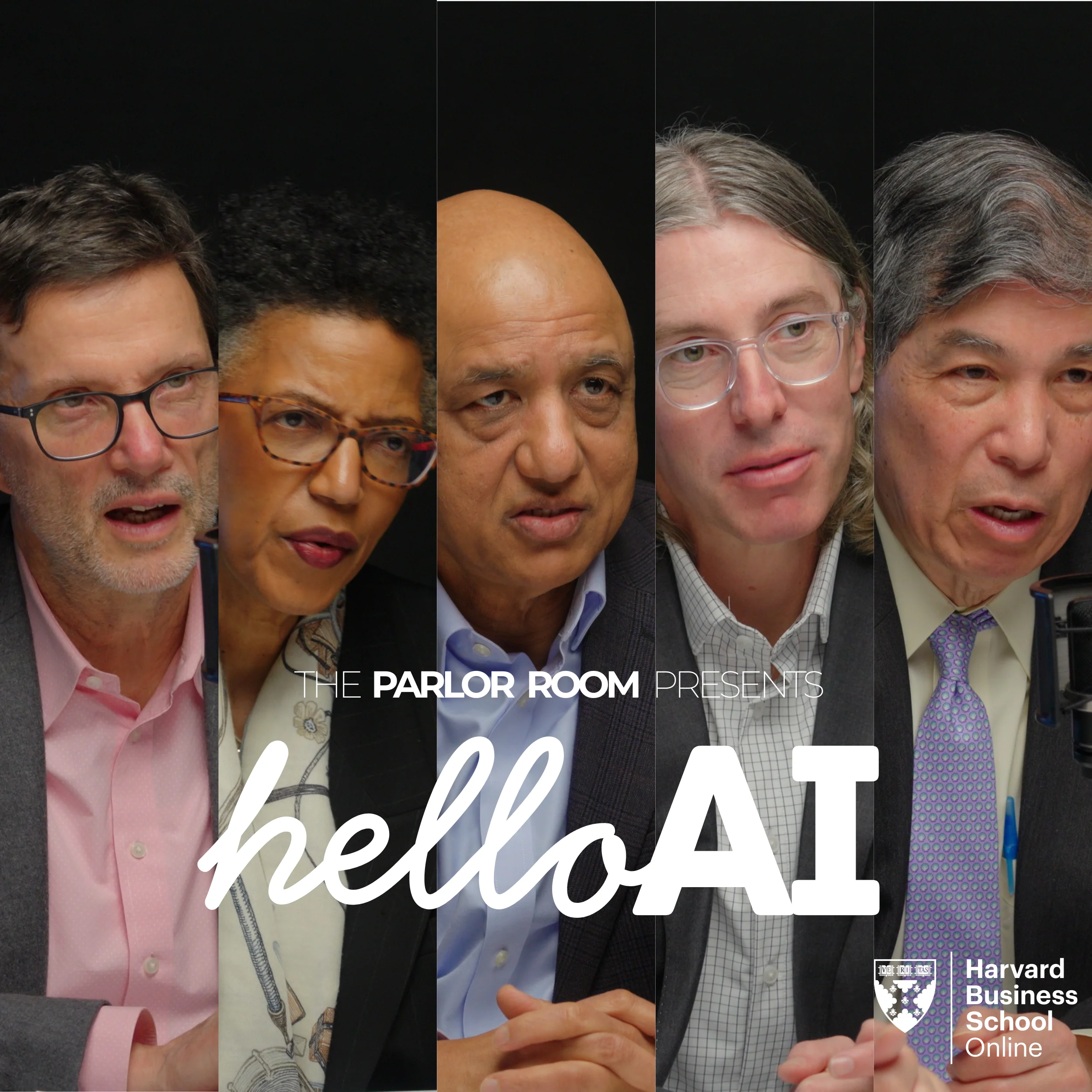
In this compilation episode of The Parlor Room Presents: Hello AI, host and Harvard Business School Online Creative Director Chris Linnane gathers HBS faculty to share actionable advice for early-career professionals. From pairing AI skills with foundational business knowledge to building relationships and making strategic career decisions, faculty share what it takes to grow and succeed in an AI-driven world.
Resources
Catch up on previous episodes of The Parlor Room, featuring faculty from this compilation episode:
You can also watch The Parlor Room on YouTube.
Transcript
Editor's Note: The following was prepared by a machine algorithm and may not perfectly reflect the interview's audio file.
Jake Cook: If the front door's locked, there's probably a way to get in the side or back door.
Chris Linnane: Starting your career right now is harder than it's ever been.
Linda Hill: Everybody has a slice of genius. Everyone has talents, and everyone has passions.
Chris Linnane: Harvard Business School faculty want to help you see what many early-career professionals are missing.
Sunil Gupta: On the one hand, you have to learn these tools. The other part is that you still need to learn the fundamentals.
Chris Linnane: The question isn't AI or experience, it's how you combine them.
Willy Shih: I think the most important thing you can do throughout your career, starting with the day you graduate, is ask yourself the question, "How am I going to keep learning?"
Chris Linnane: And some of the best advice might surprise you.
Felix Oberholzer-Gee: If I were an early job candidate and I had two job offers—one that is fully remote and one that would force me to show up in the office at 8:00 a.m.—I would definitely pick the office job.
Chris Linnane: The Parlor Room Presents: Hello AI: Early Career Advice, part one.
Chris Linnane: So, this is a slightly different kind of episode. This is a compilation episode of advice for early-career professionals. This is part one, and our first clip comes from Professor Linda Hill.
Linda Hill: So, one of the things that we say in our other work is that everybody has a slice of genius. Everyone has talents, and everyone has passions. And how big that slice is, who knows. But I do think this is a time when you should really, if you're a young person, think about your passions.
So what I always say to young people is that what you know is based on what you get to do, and what you get to do is based on who you know. So you want to think about the experiences you want to have, or you think you want to have, you don't even know what experiences yet. And you also want to think about the people who can give you access to those experiences. So think about the relationships you need to build and the experiences you need to have.
And when I say, "You need to have," I always say, "What are your passions? What do you really want to do? What kind of impact do you want to have?" And I think based on that, be much more, in some ways, be a little bit more deliberate about putting yourself in places where you can build the relationships and the kinds of relationships you need, as well as have some of those experiences. Now, the dilemma we often have is that unless you know certain people, you can't do certain things. So, as an example, my current research associate is an unbelievable Celtics fan.
Chris Linnane: Basketball team.
Linda Hill: Basketball team. Boston basketball team, yes. So I always ask my research associates when they join me, I said, "Make sure along the way you tell me what's your dream research site?" And her dream research site was studying the coach of the Celtics, Joe Mazzulla, right? This is her dream.
She said, "Here's my dream." And I'm thinking, "Okay, all right. Well, how can we get to him? What can we do?" She said, "But of course we can't do it, but that would be my dream." Now she doesn't want to be a basketball player. I don't think she wants to be a coach. Actually, she wants to do mediations of certain ... she's a fabulous person. So it turns out we were able to get to him, and he agreed to let us do it.
Chris Linnane: Wow.
Linda Hill: And I say this, and I wouldn't have thought of that. I like basketball a lot. I grew up really loving basketball, but I haven't watched it as much as I used to when I was younger in my family. But you know what? He's one of the finest leaders I've ever met. And I have to tell you the number of different lessons I learned from-
Chris Linnane: From Joe Mazzulla.
Linda Hill: From Joe Mazzulla and being able to study how you take a team of stars. And those are stars.
Chris Linnane: They're big names.
Linda Hill: Right? Big names, and make them have a sense of belonging, community, make the work meaningful, and win. And he is one of the most impressive leaders I've met in my entire academic career.
Chris Linnane: Wow.
Linda Hill: So, would I have come up with him? No. I wouldn't have just because that wasn't my dream. That was her dream. So I'm getting ready to teach a course with Tarun Khanna, one of the other faculty members. And we haven't figured it out. He's a strategy professor, but it's going to be a course where we have second-year MBAs think about moonshots. In your wildest dreams, what would you do? Or what problem would you solve? What opportunity would you take advantage of? And we're going to try to design a strategy leadership course that helps prepare them now for thinking through what they need to do to be able to do that.
And maybe it's something you can build the relationships, the expertise soon, who knows? And maybe it's going to be something that's going to take some time to get done. Maybe who knows? A decade or whatever it might be. So we're designing that course right now. So I really think people should pay attention to what excites them. Because you know what? Life is shorter than you think, but more importantly, all of this is hard work. So you may as well be doing hard work if you can, that you're prepared to do.
And if we want to live in a world where we have meritocracies, then you need to be prepared so people think, "She's ready," or, "He's ready," or, "They're ready to take on this." Because has had the right experiences, knows the right people, has the expertise necessary. Again, be zigzag about it. And that's what I would recommend.
Chris Linnane: All of the attention in the school systems towards STEM programs has set people up for these jobs that don't exist. So these kids or these young adults who are just so capable and they've put so much work and so much thought and hours into being good at these things, is there a way they can take that, not drop it, take that and find a way to add more value to what they can do for the world, for companies, for themselves?
Linda Hill: Yeah. Well, these are the people who might become the bridgers. They understand the technology. And now again, they need to make sure they understand certain contexts, because they know that context or that industry or whatever it is so well, they know how to bring those tools to that industry and help create value.
So it may be that they need to learn more about marketing or some business or something. But again, being a little bit zigzag, and it may not be ... I really would encourage them to look for opportunities to do volunteer work in different kinds of organizations to get diversity of experience and learn how to work across differences because it's going to be so important.
But yeah, I think that STEM ... I mean, I wish I did know more technology. Thank goodness I took statistics, and I understand that piece of the puzzle, and I'm not afraid of equations and algorithms. None of that just seems mysterious to me, but I would think, "Okay, what would round me out? What would complement what I already know that I could bring to an organization and make a difference?"
Chris Linnane: This next clip is marketing career-specific from Sunil Gupta.
Sunil Gupta: So I think AI can do the mechanical work. Where humans are still needed is critical thinking, judgment, and curiosity, and these tools will change. What AI can do today is different than what AI will be able to do tomorrow.
So on one hand, you have to learn these tools, and young people can perhaps learn this better than, say, the mid-career people and the older people. So if you're joining a marketing company, you should be able to know how to use AI to generate new concepts, how to use AI to target consumers, and how to use AI, perhaps, for budget allocation. So you've got to learn that.
The other part is that you still need to learn the fundamentals. You still need to learn how to build a brand. You still need to learn how to engage consumers. So those fundamental concepts don't go away; just the tools are different. So you need to learn both.
Chris Linnane: This next clip comes from Willy Shih.
Willy Shih: I think the most important thing you can do throughout your career, starting with the day you graduate, is ask yourself the question, "How am I going to keep learning?" And that means reading, right? That means maybe selected professional education down the road. It may mean taking jobs that give you exposure to those things. And I think casting a wider net, but really asking yourself is like, "Where can I go where I will keep learning?"
I think too many people are too set in their expectations of what kind of job they're willing to take at some point. Some of the most important steps I've taken in my career have involved huge step-backs in pay.
And once I relieve that constraint, I could go to things that were more risky, but also a lot more learning. And I think it is going to be very hard to replace the breadth of professional experience. So I would encourage you to think broadly, cast a wider net, but then you have to take responsibility for learning.
Chris Linnane: Our next clip comes from Felix Oberholzer-Gee.
Felix Oberholzer-Gee: Part of what you learn when you first enter the world of work is how do I work with others? How do I benefit from the expertise that's in the room? So if you can pick jobs that are more social, I think you end up learning a ton of things that will set you up with exactly the kinds of skills that are difficult to replace.
If I were an early job candidate and I had two job offers—one that is fully remote and I could work in my pajamas as long as I would like, and one that would force me to show up in the office at 8:00 a.m.—I would definitely pick the office job. Exactly because you get to learn, you get to see the kinds of ... What you talked about earlier, like these judgments, what's happening in a meeting? Who should I look at? Who can I trust? All the things that you learn early on in your career, I would definitely think that's worth getting up every single day.
Chris Linnane: That's interesting because I feel like when you've been mid-career, you've lived in both versions of this world. You were in-person for however long it was, and then you went to remote. And when you were in these remote, as remotes become more popular, you still have that knowledge base to pull on.
Felix Oberholzer-Gee: Yeah, that's exactly right. Yes.
Chris Linnane: And I never thought about the fact that it's not just that. You show up, and you've never had that knowledge base. It's not about like, "Oh, 15 years from now, I'll get that knowledge base." You never get it if you weren't interacting with people and seeing how things work in a physical space. Very interesting. So that means everyone should just take in-person jobs if they can.
Felix Oberholzer-Gee: If they can, if it's available to you or even think about, you have different options, do this or do that, but one is more social, is more engaged, gets you together with people. And maybe look at where the people are who do the kind of work that relies on a lot of intuition, a lot of experience. If you can work side by side with someone who's done the job for a long period of time, I think you pick up so much.
Early in my career, I had, maybe, she was probably the best boss I ever had. So we visited a lot of companies to check if they were worthy of the credit that we had extended. And seeing her, just the way she would walk through these factories and the questions she would ask and the way she looked at the numbers and how she triangulated between the numbers and what she saw, it was like, oh my God, I cannot begin to tell you how much I learned. It was really totally amazing.
Chris Linnane: Yeah. I haven't really given enough credit to how many things I've seen in person that have stuck with me. And if I think about the last five, six years of being online, not all the time, but a good amount, it pales in comparison to the same amount of time experience I had in-person.
Felix Oberholzer-Gee: Yeah, yeah. Yes. And in part, it's of course because you get older, and maybe the rate at which you see new things or learn new things is not quite as high as when you're completely new. But always looking for that thing where you think, okay, a lot of tacit knowledge, a lot of experience. I want to be close to those kinds of things.
Chris Linnane: And this last clip is from Jake Cook.
Jake Cook: My sympathies are with them for sure. It is a tough, tough, tough time. I think it's really hard to get hired coming fresh out of school. So what I recommend they do is, if the front door's locked, there's probably a way to get in the side or back door. And part of this is good old-fashioned hustle. Going LinkedIn and finding a leader in that company. Don't send them a spammy email; do some research. "Hey, I saw you present at this conference. I thought your talks or your post on this were really interesting. I'm looking for some advice. Would you have 10 minutes perhaps, or just answer a few questions over email?" That can be an amazing way just to get in the door to introduce yourself.
But when you show up, you've got to differentiate yourself. And if it's like, "I have this certificate," or this degree, or whatever, that's great. But what I think, especially in this day and age, if you can show you've done something, I've got projects, I've built things, that also can really help. And it displays, it's a showing, not telling them. And so like, "Oh, by the way, I'm interested in pet rescues, and I love Basset Hounds. So I built a website using AI to help Bassett Hounds get adopted. And I know you also are on the board for the Humane Shelter, Humane Society Shelter," or something like that.
Or even a better way is like, "Do you have something if you're on this board where you could use somebody as a free intern that could use this? And I've got some AI skills I've developed, and I'd like to apply them to this cause that you're a part of. If you're open to a quick chat, I'd love to see that. All I would ask is a little bit of time to get some career advice."
Those are great ways to kind of hack it, but if you go in the front door through the recruiters, I mean, all this is filtered with AI. And so, actually, it's an easier time, I think, the more human you are to be creative.
I do think the things AI can't do, if you show up with a good attitude, you don't complain about the work being assigned to you, you're down to just roll your sleeves up and get things done. You show up on time. I think all these little things that just kind of signal you're professional go a long, long way to give you an edge on that too as well.
And I think curiosity and just a positive attitude are huge. So for young people, part of doing that is finding an area that you're really interested in or passionate about, too. And sometimes it's easy to optimize for a big salary or a starting package or options or whatever, which is no shame on that. I'm not disparaging that in any way, but sometimes to do really good work and build your reputation and your skills, you've got to be able to play in an area that's easy for you, which is work to others as play to you.
And that's the big reason why I started teaching in my mid-20s was that I just loved teaching. I love to learn stuff and then share it with others. And I had a mentor of mine who started the Design School at Stanford, a professor named Jim Patell. And I was going to do my PhD, and he said, "You're wasting your time if you want to teach. Don't get a PhD to teach. You should be an adjunct."
And that set me on this path, and that has made all the difference for me because I would love ... "How do search engines work? Okay, how do I explain that to people? What tools could we use? Okay. And I need to write." So now I write books and all this stuff. And then through that act, you start to build these habits of like, "Oh, how does a large language model work? I don't know. I'm going to have to read and start to write a book, and I have to teach this thing."
And so that is play to me, but I'm also very lazy. So what I find is like when I have to teach it, and I have a deadline, and I have to get in front of a bunch of people that are expecting something, that forces the work ethic because even play at some point, you get a little bit distracted or bored. So those are two little hacks I found early in my career that really helped.
And that's a great way for an entry-level person to go in. And if you like AI or tech, or you're interested in what these new uses could be, teach something at the lunch and learn. Go, "Hey, I know some people are curious how we could use this to write better emails." If I present something in three weeks, would that be okay on both?" I mean, every manager like, "Yeah, great. It's not me pushing it. You're going to do it? Great. Awesome."
And you build your personal reputation internally, like, "Oh, wow, Sarah is actually, she's a go-getter, she's curious, and she's trying to help the rest of the people, and she's helping Abdul and Brian get up to speed on these things, which is great." I mean, that's that part of that young person starts with that reputation, and there's a natural bias to look to the young to understand these new waves.
Chris Linnane: Sure.
Jake Cook: So they do have that tailwind pushing them forward on that for sure.
Chris Linnane: That's a really interesting perspective, too, that it's more native to them is at least the perspective that most people have. So it's like, "Well, you do have that one up that you've lived in this world from day one for yourself."
Jake Cook: "You grew up with the phone, you understand digital, right? You're young, you get this stuff, right? I don't." And so I think there's a part where we're in a really interesting spot where I think a lot of people can really leapfrog up as a result of being fluent in some of this stuff. And the way that you get fluent is you have to play with it.
Chris Linnane: The Friday night experiment.
Jake Cook: Yeah. And the way to play with it is to find an area you're normally just passionate about and then apply AI in those areas. Maybe not buying chainsaws or things like that, but-
Chris Linnane: Low stake, pizza. Stick with the pizza.
Jake Cook: Stick with pizza. Yeah, definitely.
Chris Linnane: Thank you for watching. Stay tuned for part two later this season. And please be sure to subscribe and follow wherever you watch or listen to your podcasts. Thanks for listening. Thanks for watching.