Apply frameworks, tools, and goal-setting and tracking exercises to your own strategic initiatives
Evaluate and elevate your team’s management of the core tensions of strategy execution, including how to balance growth, profit, and control
Design measurement systems for every dimension of business performance
Identify and manage risks that could derail strategy execution
Empower employees through proprietary frameworks like the Job Design Optimization Tool, which helps design high-performance jobs that enhance a team’s ability to execute critical responsibilities
Foster successful strategy execution by establishing an environment that communicates which opportunities and behaviors are encouraged and which are out of bounds
Who Will Benefit
Gain the frameworks and tools to improve strategy execution within your team, department, or organization.
I was impressed by how well the course material fit my personal challenges and goals at work, and how easy it was to use the material to improve my team’s strategy execution.
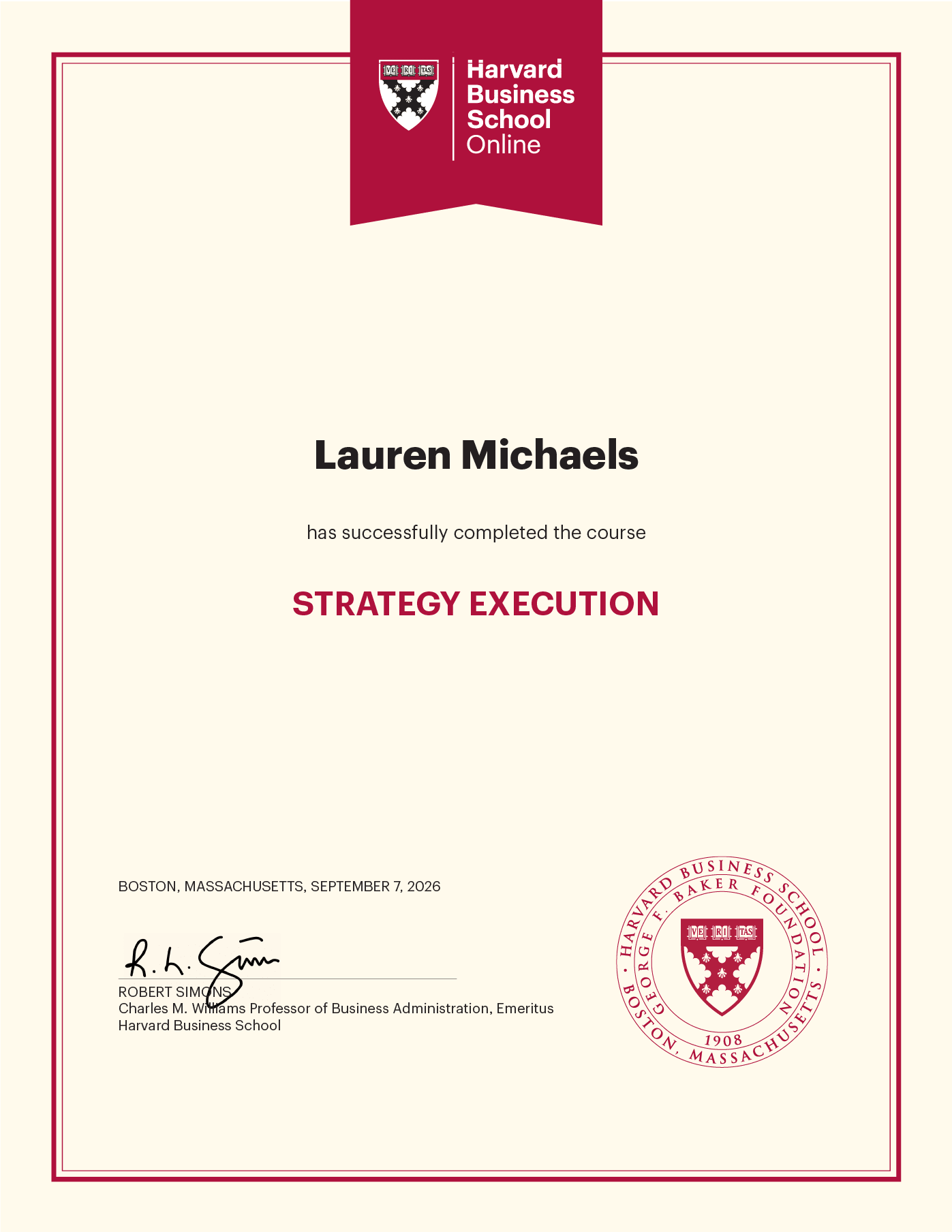
Certificate of Completion Boost your resume with a Certificate of Completion from HBS Online Earn by: completing this course
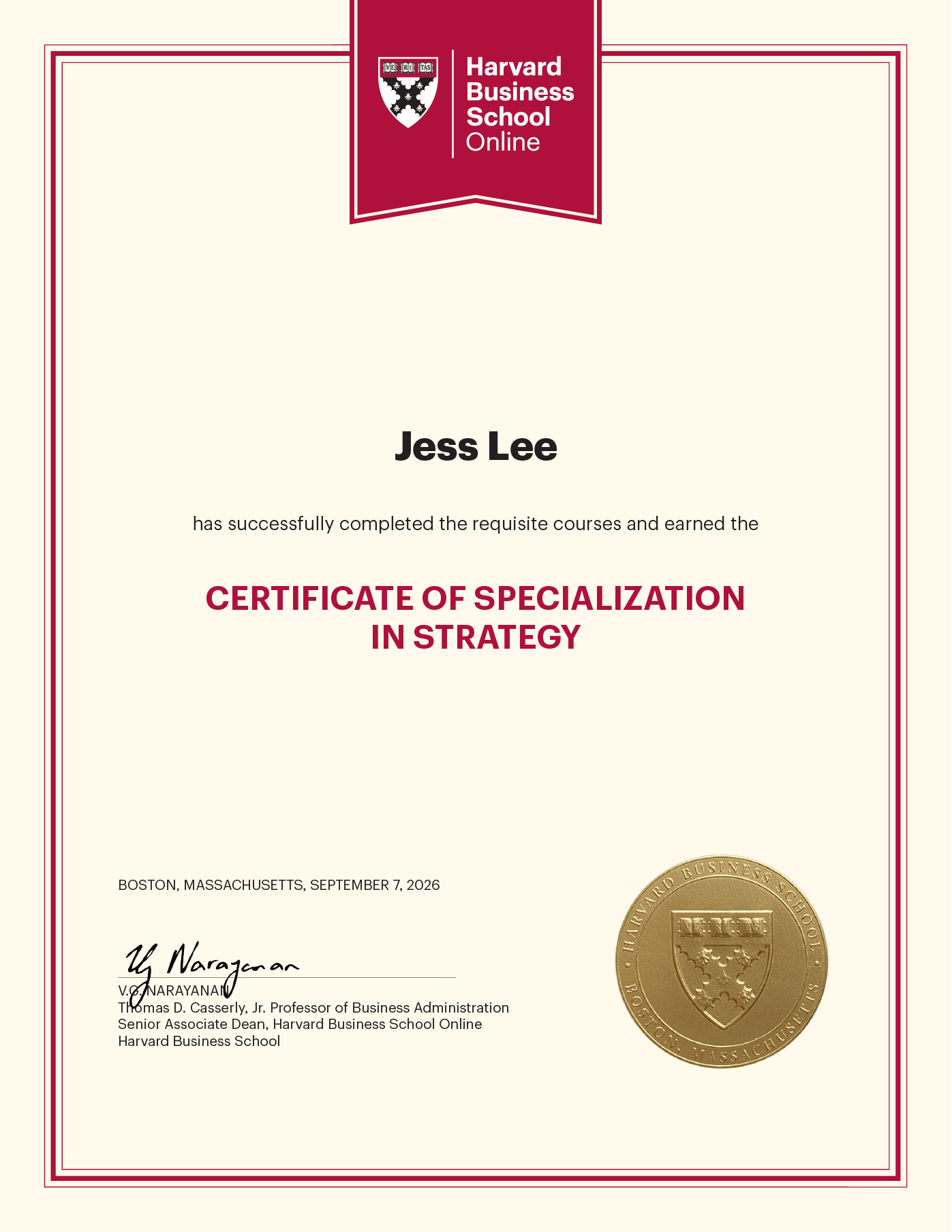
Certificate of Specialization Prove your mastery of strategy or leadership and management Earn by: completing any three courses within either subject area to earn a Certificate of Specialization
Understand the various tensions managers face as they execute strategy and implement a framework for managing those tensions effectively.
Highlights
PlayVideo duration:0:41
Making Tough Choices
PlayVideo duration:1:07
Push to Profitability
Concepts
Making Tough Choices: Course Introduction
Balancing Innovation and Control, Part I
Balancing Innovation and Control, Part II
Managing Other Organizational Tensions
Analyzing the Four Ps of Strategy, Part I
Analyzing the Four Ps of Strategy, Part II
Featured Exercises
Analyze your organization’s approach to managing common organizational tensions
Identify strengths and deltas in your organization’s approach to executing strategy
Module 2
Aligning Job Design to Strategy
5-6 Hours
Optimize the design of key jobs and align them to your organization's strategy.
Highlights
PlayVideo duration:0:48
Performing the X-Test
PlayVideo duration:0:56
Span of Support
Concepts
Designing High-Performing Jobs
Understanding the Entrepreneurial Gap
Identifying Spans of Influence and Support
Balancing Supply and Demand in a Job
Analyzing and Improving Job Design
Featured Exercises
Analyze a job using the Job Design Optimization Tool (JDOT)
Recommend a set of job design improvements
Module 3
Energizing Employees to Execute Strategy
5-6 Hours
Apply techniques to spur high performance and creativity among employees and create core values that inspire and guide employees through difficult decisions.
Highlights
PlayVideo duration:1:10
Designing Stretch Goals
PlayVideo duration:0:36
Prioritizing Constituents in Your Core Values
Concepts
Generating Creative Tension, Part I
Generating Creative Tension, Part II
Defining Core Values
Communicating Core Values
Featured Exercises
Identify ways to dial up performance and increase innovation within your team
Evaluate the effectiveness of your organization’s core values
Module 4
Measuring and Monitoring Performance
6-7 Hours
Create performance measurement systems that account for all dimensions of strategy execution while conserving scarce time and attention.
Highlights
PlayVideo duration:1:19
The Benefits of Diagnostic Control Systems
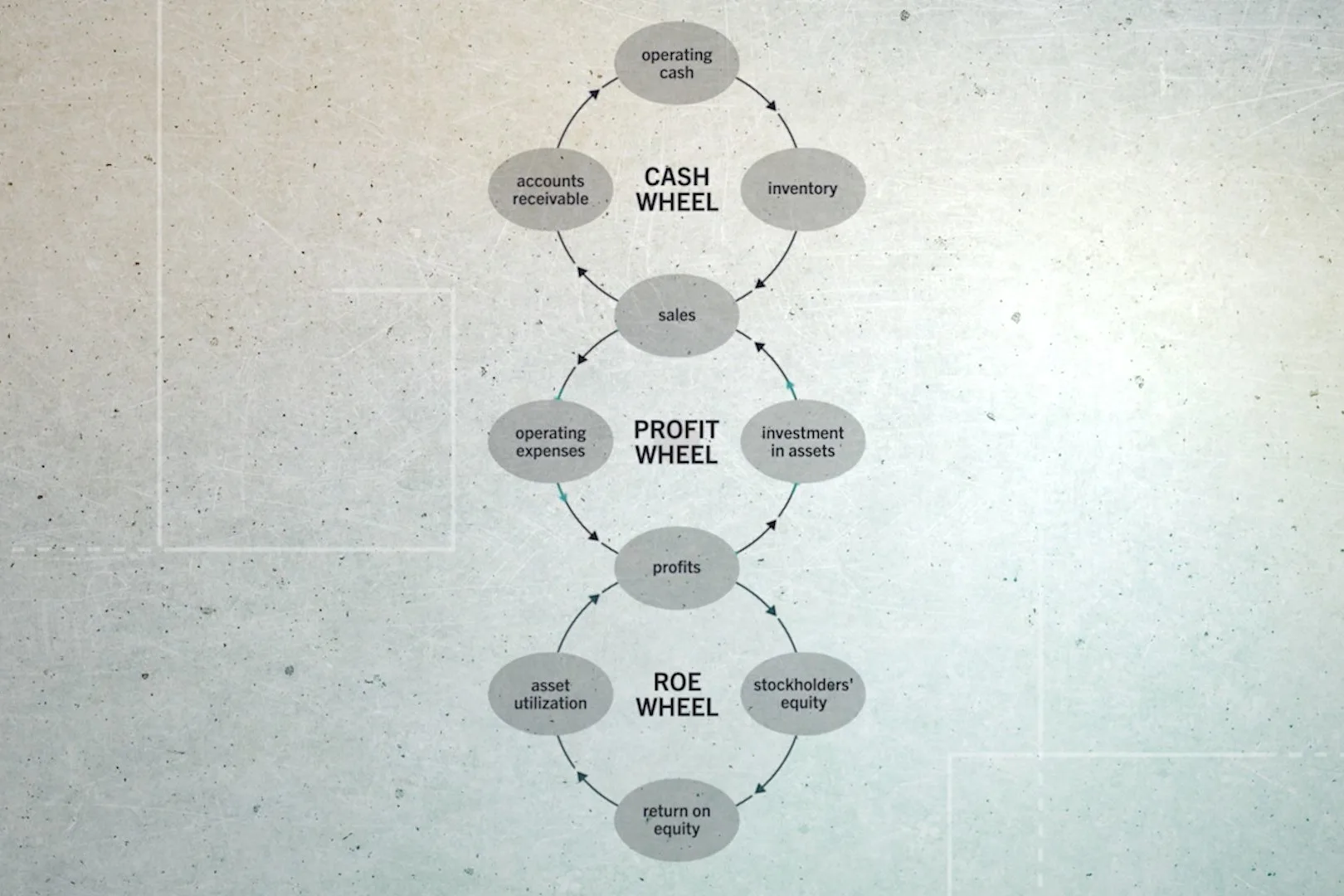
Putting the Three Wheels Back Together - Three Wheels of Profit Planning Schematic
Concepts
Designing Diagnostic Control Systems
Introducing the Three Wheels of Profit Planning
Building a Balanced Scorecard
Selecting Goals and Measures
Powering up Performance Goals with Incentives, Part I
Powering up Performance Goals with Incentives, Part II
Featured Exercises
Analyze and improve your organization’s approach to profit planning
Identify critical performance variables and develop goals, measures, and targets corresponding to them
Analyze a range of incentive types and identify the most useful ones for different contexts
Module 5
Identifying and Managing Risks
5-6 Hours
Describe and identify common risks businesses face and create systems for managing and mitigating them.
Highlights
PlayVideo duration:0:46
Considering the Balance Between Innovation and Control
PlayVideo duration:0:34
Operations Risk
Concepts
Identifying Sources of Risk, Part I
Identifying Sources of Risk, Part II
Assessing Internal Risk Pressures
Designing and Enforcing Internal Controls
Building Business Conduct Boundaries
Featured Exercises
Identify internal risk pressures using the Risk Exposure Calculator
Propose solutions for a new conduct boundary at your organization
Module 6
Balancing Innovation and Control
7-8 Hours
Apply techniques to help your business innovate and adapt to change while maintaining clear focus and retaining necessary controls.
Highlights
PlayVideo duration:0:52
Using Control Systems Interactively
PlayVideo duration:0:31
Discussing Challenges in San Jose
Concepts
Unleashing Freedom through Strategic Boundaries
Adapting to Change: Interactive Control Systems
Reviewing the Levers of Control
Implementing the Levers of Control, Part I
Implementing the Levers of Control, Part II
Featured Exercises
Identify which opportunities your organization should and should not pursue
Propose a system you can use to focus organizational attention on emerging threats and uncertainties
Apply course-wide knowledge by proposing a set of solutions to strategy execution challenges at a growing consulting firm
Capstone activity: develop an action plan for implementing the levers of control at your or another organization
Baker Foundation Professor, Charles M. Williams Professor of Business Administration, Emeritus
Experience
Strategy Execution equips current and aspiring managers with the tools, skills, and frameworks to allocate resources, measure performance, manage risk, and successfully implement strategy.
Immersive Learning
Stay active by engaging in a new activity every three to five minutes and applying your knowledge through interactive tools and a capstone assignment.
PlayVideo duration:0:09
HBS Online courses allow you to immerse yourself in a dynamic, interactive learning experience. You’ll engage in a new activity every three to five minutes and apply your knowledge through polls, quizzes, and problem-solving exercises designed to accelerate and reinforce your learning.
Real-World Connections
Get social by collaborating with a global community of peers before, during, and after your course. Learners who successfully complete an HBS Online program will be added to the HBS Online Community's Official Networking Group and gain exclusive access to events and other networking opportunities.
PlayVideo duration:0:08
See how the HBS Online course platform engages you in social learning. You exchange ideas, offer input, and seek out viewpoints from a community of learners gathered from around the globe. In the process, you learn from each other’s experiences and perspectives, and leave the program with a broader outlook on the world.
Real-World Cases
Immerse yourself in real-world, case-based examples brought to life by industry-leading experts from companies like Marriott, adidas, Quiet Logistics, and Go Mobile.
PlayVideo duration:0:11
Our courses allow you to apply your learning through real-world examples and experience Harvard Business School’s signature case method. You’ll leverage course concepts, vital tools and frameworks, and the diversity of your peers’ perspectives to analyze the problem and determine a path forward.
PlayVideo duration:0:09
HBS Online courses allow you to immerse yourself in a dynamic, interactive learning experience. You’ll engage in a new activity every three to five minutes and apply your knowledge through polls, quizzes, and problem-solving exercises designed to accelerate and reinforce your learning.
Taking classes from Harvard Business School Online, you don't just learn the frameworks, you live them.
Asiye Cerkezoglu
Financial Planning & Analysis, Management Reporting Vice President, Fiba Faktoring
Strategy Execution FAQs
Free E-Book
How to Formulate a Successful Business Strategy
This guide will equip you with the tools, frameworks, and knowledge to formulate a successful business strategy that propels your organization forward.
Bring HBS Online’s flexible, scalable, and high-impact learning experiences to your organization through shared learning and group discounts for teams of five or more.