Design Thinking and Innovation
Leverage design thinking principles and creative problem-solving tools to develop innovative solutions to your most challenging business problems.
Who Will Benefit
What You'll Earn
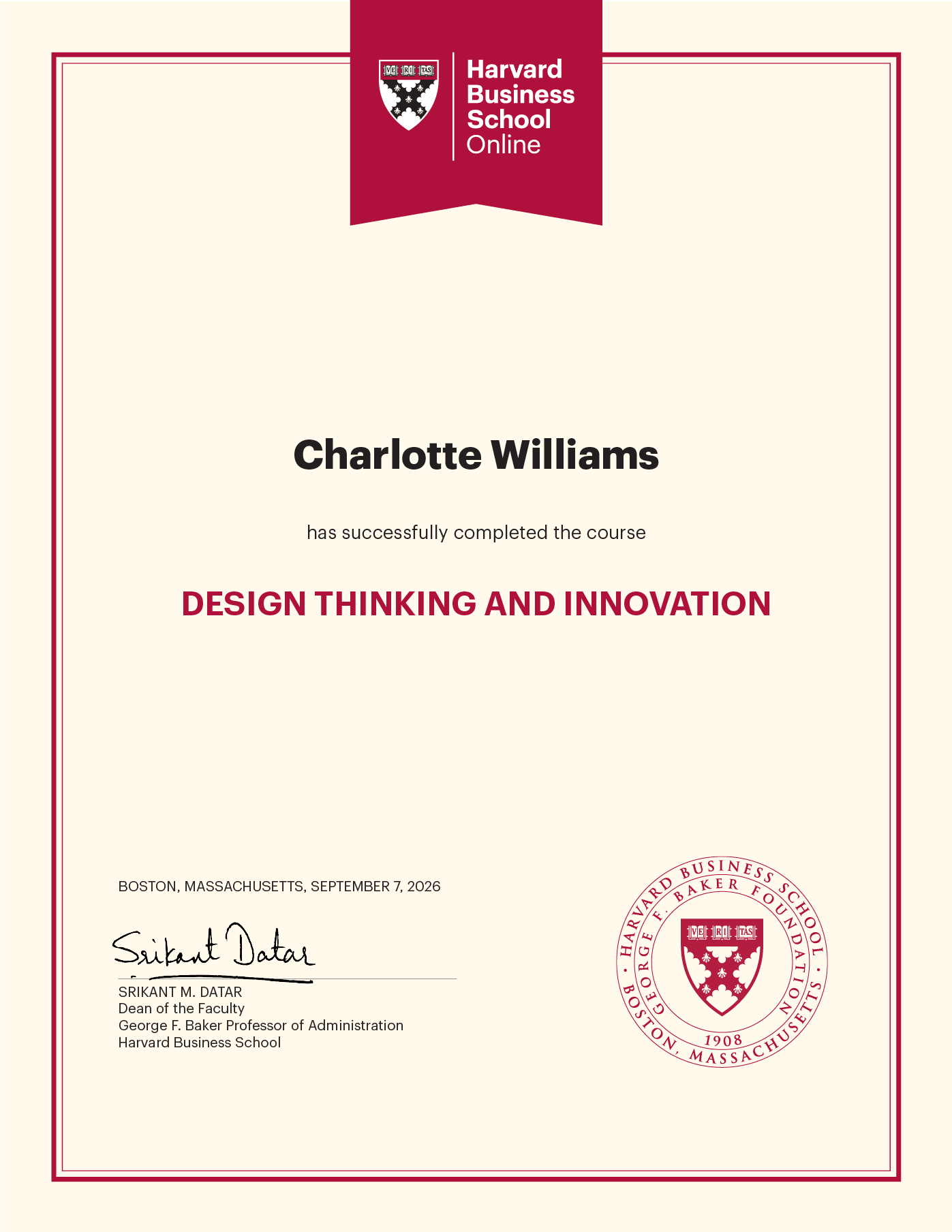
Certificate of Completion
Boost your resume with a Certificate of Completion from HBS Online
Earn by: completing this course
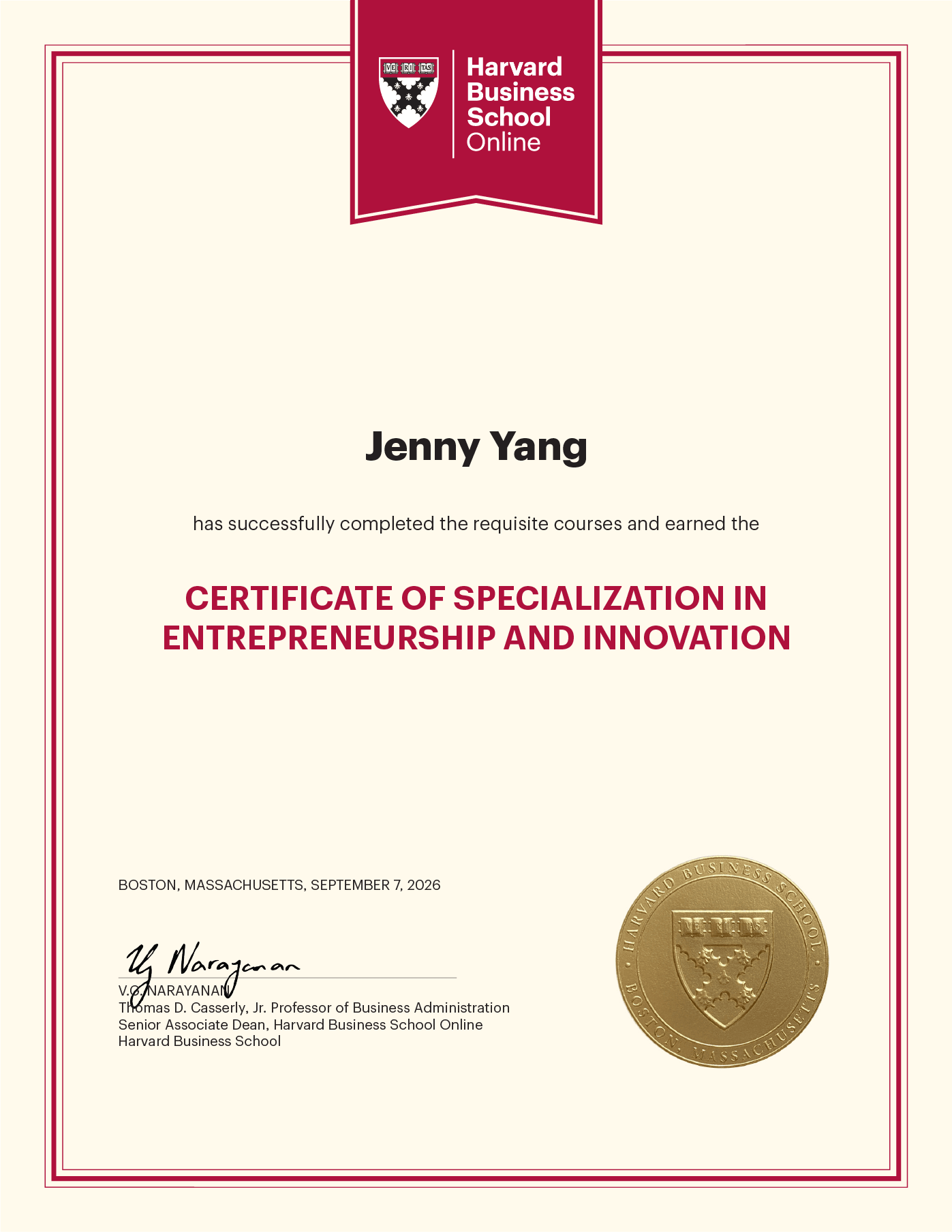
Certificate of Specialization
Prove your mastery of entrepreneurship and innovation
Earn by: completing any three courses within this subject area to earn a Certificate of Specialization
Course Syllabus
7 Modules, 40-50 Hours
Content Week - Clarify: Empathy and Understanding
Define users' explicit pain points and latent needs to identify the most game-changing part of a problem, and analyze your organization's capacity for innovative thinking.

What Is Innovation?
Structuring Observations Using Journey Maps
Concepts
An Introduction to Innovation
Clarify Through Observation
Insights and Problem Framing
The Right Enviroment for Creativity
Featured Exercises
Problem Framing: Reframe problems from various perspectives (deep, emotional, broad, and dynamic) to identify new pain points and make new solutions possible
Project Week – Clarify
Practice researching the innovation context and empathizing with users through structured tools.

Project Week Assignment
Concepts
Project Instructions
Featured Exercises
Project: Apply tools from Module 1 to an innovation problem of your own choosing, or a provided scenario
Content Week - Ideate, Part 1: Tools for Generating Ideas
Develop design principles to create user-focused ideas, experiment with ideation tools, and explore different ideation approaches, such as alternate worlds and brainstorming.

Ideation and Cognitive Fixedness
Opportunities in 2 by 2 Frameworks
Concepts
Establishing Focus with Design Principles
The Ideation Process: Getting Started with SIT
More SIT Tools for Ideation
Open-Ended Approaches to Generating Ideas
Review of Project Work
Featured Exercises
SIT’s Closed World: Divide an existing product, service, model, or strategy into components and manipulate them to break cognitive fixedness and generate ideas
Content Week - Ideate, Part 2: User Values and Behaviors
Refine innovation ideas using design heuristics and apply research-based personas and behavior models to make innovations easier to adopt.
Match Mental Models, Reduce Complexity, and Prevent Errors
Developing Research-Based Personas
Concepts
Design Heuristics for Generating and Refining Ideas
Designing for Behavior Change
Featured Exercises
B. J. Fogg Behavioral Model: Identify prompts to improve users’ ability and motivation to engage in a desired behavior
Project Week - Ideate
Practice generating ideas and evaluating them against research and key insights through structured tools.
Project Week Assignment
Concepts
Project Instructions
Featured Exercises
Project: Apply tools from Modules 3 and 4 to your innovation problem or the provided scenario
Content Week - Develop: An Experimentation Mindset
Develop, assess, and strengthen innovation concepts, and guide prototyping by creating critical questions related to a concept's desirability, feasibility, and viability.

Impact, Difficulty, and Innovation Sweet Spot
Near Far Sweet
Concepts
Idea Selection and Evaluation
Defining and Refining Your Prototype Plan
Prototyping: From Exploration to Validation
Leading Concept Development
Featured Exercises
Concept Poster: Organize all information about an innovation concept to identify critical questions for prototyping
Content Week - Implement: Communication and Structure
Assess developer and user perspectives for bias, apply frameworks to communicate an innovation's value, and reflect on management skills for sustaining a culture of innovation.
The Curse of Knowledge
The Elephant and Rider Framework
Concepts
Overcoming Developer and User Bias
Strategies for Communicating Value
Managing an Innovation Culture
Featured Exercises
Stakeholder Analysis: Compare the resistance and status-quo bias of key stakeholders and develop a communication plan
Upcoming Cohorts
| Start Date | Pay by | Price | Time | Calendar |
|---|---|---|---|---|
| Oct 28, 2026 | Oct 26, 2026 | $1,949 | 42-56 hrs, 6-8 hrs/week | Oct 28, 2026 Calendar |
| Jan 13, 2027 | Jan 11, 2027 | $1,949 | 42-56 hrs, 6-8 hrs/week | Jan 13, 2027 Calendar |
| Mar 24, 2027 | Mar 22, 2027 | $1,949 | 42-56 hrs, 6-8 hrs/week | Mar 24, 2027 Calendar |
Led by World-Renowned HBS Faculty
Srikant M. Datar
George F. Baker Professor of Administration, Dean of the Faculty

Experience
Immersive Learning
Stay active by engaging in a new activity every three to five minutes and applying your knowledge through two weeks of project work.
HBS Online courses allow you to immerse yourself in a
dynamic, interactive learning experience. You’ll engage in a new activity every
three to five minutes and apply your knowledge through polls, quizzes, and
problem-solving exercises designed to accelerate and reinforce your learning.
Real-World Connections
Get social by collaborating with a global community of peers before, during, and after your course. Learners who successfully complete an HBS Online program will be added to the HBS Online Community's Official Networking Group and gain exclusive access to events and other networking opportunities.
See how the HBS Online course platform engages you in social learning. You exchange ideas, offer input, and seek out viewpoints from a community of learners gathered from around the globe. In the process, you learn from each other’s experiences and perspectives, and leave the program with a broader outlook on the world.
Real-World Cases
Immerse yourself in real-world, case-based examples brought to life by industry-leading experts from companies like Moderna, IBM, T-Mobile, and Royal Philips.
Our courses allow you to apply your learning through
real-world examples and experience Harvard Business School’s signature case
method. Business leaders will share challenges they’ve faced. As the story
unfolds, you’ll leverage course concepts, vital tools and frameworks, and the
diversity of your peers’ perspectives to analyze the problem and determine a
path forward.
HBS Online courses allow you to immerse yourself in a
dynamic, interactive learning experience. You’ll engage in a new activity every
three to five minutes and apply your knowledge through polls, quizzes, and
problem-solving exercises designed to accelerate and reinforce your learning.
Real-World Outcomes
Don’t be intimidated by the Harvard name or the price tag. Try one course; you’ll discover real value—not just in what you learn, but in the people you meet.
Ieva RužaMedical Doctor, Riga East Clinical University Hospital

Design Thinking and Innovation FAQs
Free E-Book
So You Want to Be an Entrepreneur: How to Get Started
In this guide, you’ll learn about what characterizes a successful entrepreneur, how to decide if entrepreneurship is right for you, and what skills you need to thrive.

Solutions for Organizations
Empower Your Team with HBS Online
Bring HBS Online’s flexible, scalable, and high-impact learning experiences to your organization through shared learning and group discounts for teams of five or more.