
No matter your organization's size, industry, or business model, success depends on one thing: creating value for customers.
But value isn’t about having the most advanced product or the lowest price. It’s about how customers weigh what they get against what they give up.
Consider a local coffee shop versus a national chain. The independent shop may serve higher-quality coffee, while the chain delivers speed, consistency, and convenience. Even if the product is objectively better at the local shop, many customers still choose the chain because the overall experience aligns more closely with what they value.
To unlock your business’s full potential, you need to understand what drives value—and how to shape it strategically.
Featured Certificate Course
Business Strategy
Formulate strategies that give your organization a competitive advantage, using a proven framework that creates value for customers, employees, and suppliers.
Self-Paced | 6 Modules | 5-6 Hours per Module | $1,949
What Is Value Creation?
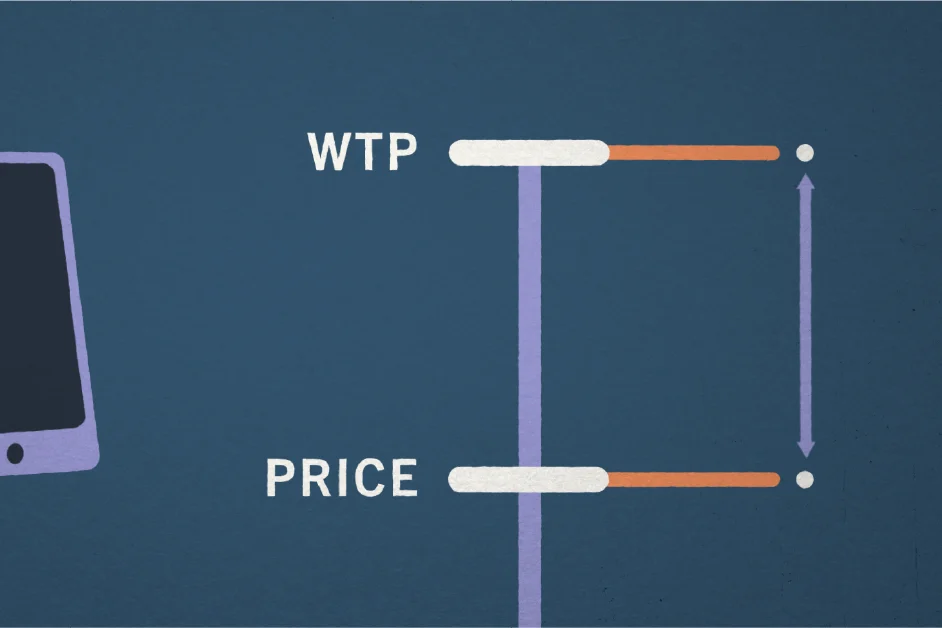
At its core, value creation is the difference between how much a customer values a product and what they're willing to pay for it.
As Harvard Business School Professor Felix Oberholzer-Gee explains in the online course Business Strategy, "Value is always a difference.” The larger the difference, the more compelling your offering becomes.
As outlined in Business Strategy, companies increase value in two fundamental ways:
Increasing customers’ willingness to pay (WTP)
Decreasing employees’ and suppliers' willingness to sell (WTS)
Everything else—branding, pricing, operations, innovation—is a lever to influence one of those forces.
“The companies that create the most value for their customers are the companies that are also the most profitable," Oberholzer‑Gee says in Business Strategy.
Competitive advantage doesn’t come from having the “best” product. It comes from consistently making your offering more valuable to customers.
What Is Value in Business?
“All financial success is built by creating value,” Oberholzer-Gee emphasizes in Business Strategy.
For every deal, project, or strategic initiative, understanding how to increase WTP or decrease WTS drives performance.
Value isn't experienced by just one group. Customers, employees, and suppliers all experience it differently—and an effective strategy accounts for all three.
"As strategists, we really ask three questions: How can my business best create value for customers? How can my business create value for employees? And how can my business create value by collaborating with suppliers?” Oberholzer-Gee explains in Business Strategy.
Those three questions form the backbone of modern strategic thinking.
A useful way to think about this is through the “value stick,” explained in Business Strategy, which maps four essential elements:
Willingness to pay (WTP)
Price
Cost
Willingness to sell (WTS)
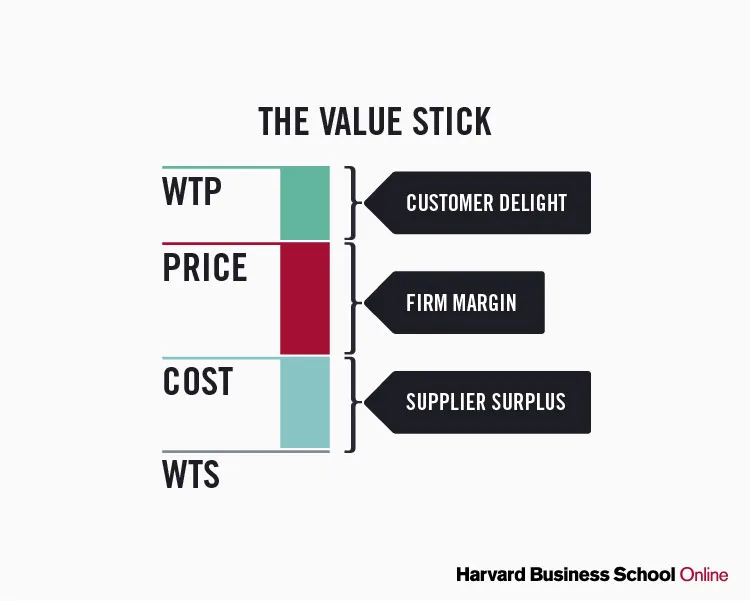
As Oberholzer-Gee stresses in Business Strategy, “The difference between willingness to pay and price is value for the customer. We will call it customer delight. The difference between price and cost is the margin that the company earns.”
Best Buy's turnaround under former president and CEO Hubert Joly, highlighted in Business Strategy, is a strong example of powerful value creation.
When Joly stepped in as CEO, the company was losing billions. Investors urged him to close stores and cut staff.
Instead, he reframed the company’s physical footprint as a strategic asset. He transformed stores into mini-warehouses for faster shipping and invited major technology brands to build dedicated showrooms within them.
As Joly explains in Business Strategy, vendors had a choice: "Either building their own stores or using our stores and building Samsung stores within our stores. And so this was good for the customer, because in the same place, they could see all of the world's best products from all of these big brands."
This strategy created value on both ends:
Vendors lowered their WTS by avoiding investment in standalone retail locations
Customers raised their WTP due to expert advice, immersive experiences, and faster fulfillment
When a strategy benefits multiple stakeholders, value creation follows.
3 Value Creation Strategies to Apply to Your Business
1. Map the Full Customer Journey
Innovation doesn't begin with brainstorming sessions or feature upgrades; it starts with paying attention.
When companies fixate on the product itself, they often overlook the friction points that shape the overall customer experience.
Former HBS Professor Bharat Anand, featured in Business Strategy, notes that asking what customers are willing to pay “forces you to think about the full customer experience as opposed to simply product features." That shift in perspective surfaces the unmet needs that spark meaningful creation.
Anand illustrates this technique through Amazon Kindle's success, mentioned in Business Strategy. Sony launched its e‑reader, the Librie, more than a year before the Kindle. On paper, the devices were nearly identical with similar storage, battery life, and price points. Yet the Kindle became a runaway success while the Librie faded.
The difference wasn't the device—it was the experience.
Loading a book onto the Sony Librie required downloading files to a computer, connecting the device with a cable, and manually transferring content. Amazon eliminated all of that.
"The real innovation of the Kindle had much less to do with e-reading or battery life or storage capacity. It had everything to do with e-purchasing,” Anand stresses in Business Strategy.
Sony mapped the product. Amazon mapped the entire customer journey.
Often, the greatest gains in value come not from changing the product itself, but from understanding how customers perceive it.
2. Pursue a Dual Advantage
The most effective value-creation strategies don't just raise WTP or lower WTS—they do both simultaneously. In Business Strategy, Oberholzer-Gee calls this a dual advantage.
While dual advantages can emerge from pricing, product design, or operations, some of the most compelling examples come from companies that remove friction for one stakeholder group while benefiting another.
E-commerce platform Taobao’s rise in China, as illustrated in Business Strategy, captures this dynamic vividly.
When Taobao entered the market, millions of consumers were curious about online shopping but hesitant to trust it. These individuals were what Oberholzer‑Gee calls near‑customers.
“Near-customers are individuals who are not in the market today," Oberholzer-Gee explains in Business Strategy. "We don't observe them, and we typically don't have data for them. But their willingness to pay is reasonably close to the current price.”
Rather than competing for eBay’s existing users, Taobao focused on these near‑customers by addressing the core barrier keeping them out of the market: uncertainty.
The company introduced Alipay, an escrow system that held payments until buyers confirmed satisfaction; WangWang, a tool that allowed customers to chat directly with vendors; and a merchant verification system tied to national ID cards, giving customers confidence that sellers were legitimate.
These features “created a shopping experience that was remarkably similar to brick‑and‑mortar shopping," Oberholzer-Gee notes in Business Strategy.
At the same time, Taobao made the platform more attractive to sellers. Unlike eBay, it eliminated listing fees, lowering the cost of entry. Sellers also benefited from a growing customer base, fewer disputes, clearer communication, and a more predictable transaction environment.
By reducing disintermediation risk, Taobao made participation easier and more rewarding for sellers as well. This is dual advantage in action: a strategy that expands total value and shares it across the organization.
3. Leverage Your Brand Strategically
A strong brand is a powerful value driver, but only when you understand how it works.
In Business Strategy, Oberholzer‑Gee identifies three: "A first is that they confer status. Second, brands help mitigate uncertainty. Third, brands influence taste. You tend to like the brands that you encounter early in your life."
Gucci, highlighted in Business Strategy, demonstrates how brands can create value across segments. Luxury consumers vary in how they signal status:
Patricians have significant wealth and prefer subtle, understated products. They rely on quiet signals—minimal logos and refined design—because their peers can recognize and interpret these cues.
Parvenus are also affluent but seek visible displays of status. They gravitate toward bold logos and prominent branding that signal wealth to a broader audience.
Posers aspire to luxury status but lack the financial means for authentic goods. Motivated by social signaling, they often turn to counterfeits to emulate more affluent groups.
To appeal to each group, Gucci offers products at different price points and visibility levels—capturing value without diluting brand equity.
Mercedes-Benz, featured in Business Strategy, follows a similar playbook. The company places its iconic star on nearly every model but adjusts its size by price point.
"The least expensive models tend to have the largest stars; some customer groups prefer loud brand signals," Oberholzer-Gee says in Business Strategy. "The most affluent consumers, however, value understatement. The priciest models have the smallest stars."
The takeaway: brand value depends on how well it aligns with customer motivations. When done right, it increases perceived value and strengthens competitive advantage.
Free E-Book
How to Formulate a Successful Business Strategy
This guide will equip you with the tools, frameworks, and knowledge to formulate a successful business strategy that propels your organization forward.
Start Creating Real Business Value with HBS Online
Value creation isn’t a single tactic; it’s a mindset. It shapes every strategic decision you make—from how you design products to how you price, position, and grow them.
Whether you’re mapping the customer journey, refining your brand strategy, or identifying overlooked near-customers, the principle remains the same: value is created when your offering becomes more attractive relative to alternatives.
Are you ready to deepen your understanding of value creation and apply new strategies to your own organization? Explore our online course Business Strategy and download our free strategy formulation e-book to get started.