
Conflict can arise whenever you live, work, or collaborate with others. In workplaces, where employees bring different backgrounds, personalities, opinions, and experiences, it’s crucial to understand what causes conflict and how to resolve it.
Common reasons for workplace conflict include:
Misunderstandings or communication breakdowns
Differing opinions, viewpoints, or personalities
Variations in learning or processing styles
Perceptions of unfairness
Although conflict is common, many people aren’t comfortable handling it—especially with colleagues. As a business leader, you’ll need to navigate disagreements of your own and help your team work through disputes.
Here’s why conflict resolution matters and five strategies for approaching it.
Featured Certificate Course
Leadership, Ethics, and Corporate Accountability
Lead with integrity by navigating tough decisions, stakeholder expectations, and organizational accountability.
Self-Paced | 5 Modules | 7-9 Hours per Module | $1,949
Why Is Addressing Workplace Conflict Important?
Pretending conflict doesn’t exist won’t make it go away. Ignoring issues can lead to missed deadlines, festering resentment, and failed initiatives.
According to conflict resolution firm Pollack Peacebuilding Systems, managers spend over four hours a week on conflict resolution, yet 60 percent of employees never received conflict management training. That adds up: Workplace conflict is estimated to consume more than $414 billion worth of paid work time annually across the U.S. economy.
As a leader, you’re responsible for fostering healthy conflict resolution and creating a safe, productive work environment for your employees.
“Some rights, such as the right to safe working conditions or the right against sexual harassment, are fundamental to the employment relationship,” says Harvard Business School Professor Nien-hê Hsieh in the online course Leadership, Ethics, and Corporate Accountability. “These rights are things that employees should be entitled to no matter what. They’re often written into the law, but even when they aren’t, they’re central to the ethical treatment of others, which involves respecting the inherent dignity and intrinsic worth of each individual.”
Resolving disputes effectively as they arise benefits both your employees’ well-being and your company’s financial health. The first step is learning the five conflict resolution strategies at your disposal.
Explore how to approach conflict in the workplace in the video below, and be sure to subscribe to our YouTube channel for more explainer content.
Workplaces bring together employees with different backgrounds, personalities, opinions, and experiences. Conflict is inevitable, making it crucial to understand its causes and how to resolve it.
5 Strategies for Conflict Resolution in the Workplace
While there are several approaches to conflict, some tend to be more effective than others. The Thomas-Kilmann Conflict Model—developed by Dr. Kenneth W. Thomas and Dr. Ralph H. Kilmann—outlines five strategies for resolving conflict:
Avoiding
Competing
Accommodating
Compromising
Collaborating
These strategies fall on a graph, with "assertiveness" on the y-axis and "cooperativeness" on the x-axis:
Assertiveness: How much you try to achieve your own goal
Cooperativeness: How much you try to satisfy the other party’s goal
You can also think of these axes as the “importance of my goal” versus the “importance of this relationship.”
When your assertiveness is high, you’re focused on achieving your own goal. When your cooperativeness is high, you’re focused on helping the other person reach theirs to preserve the relationship.
Here’s a breakdown of the five strategies and when to use each.
1. Avoiding
Avoiding works best in situations where the relationship and the goal are both low priority.
You’re unlikely to encounter these scenarios at work, though they can come up in daily life. Imagine you’re on a public bus and the passenger next to you is playing music loudly. You’ll probably never bump into that person again, and a pleasant bus ride isn’t a pressing goal. So, ignoring the music and avoiding conflict is a reasonable choice.
In workplace conflicts—where your goals are typically important, and you care about maintaining a lasting relationship with colleagues—avoidance can be detrimental.
Remember: Some situations require avoiding conflict, but you’re unlikely to encounter them in the workplace.
2. Competing
Competing is another strategy that isn’t often well-suited for workplace conflict, but it can be useful in certain situations.
This conflict style is for scenarios in which you place high importance on your goal and low importance on your relationships with others. It’s high in assertiveness and low in cooperation.
A competing style can be the right call in a crisis. For example, if someone is unconscious and people are arguing over what to do, asserting yourself and taking charge can get that person medical attention faster.
It’s also useful when you’re standing up for yourself or feel unsafe. In those cases, asserting yourself and reaching safety matters more than the relationship.
Using a competing style in situations where relationships matter—with a colleague, for instance—can undermine trust, along with collaboration, creativity, and productivity.
3. Accommodating
The third strategy is accommodating, in which you give in to the other party’s needs. Use it when the relationship matters more than the goal.
For example, say you pitch an idea for a future project in a meeting, and a colleague argues it will have a negative impact. You could resolve the conflict by dropping your original idea.
This is useful if the other person is angry or hostile, or you don’t have a strong opinion on the matter. It immediately de-escalates conflict by removing your goal from the equation.
Accommodation has its place at work, but it’s worth asking whether you’re using it just to dodge conflict. Simply giving in whenever someone disagrees with you can snuff out opportunities for innovation and creative problem-solving.
As a leader, pay attention to whether your employees fall back on accommodation too often. In a safe environment, encouraging healthy debate can lead to stronger collaboration.
4. Compromising
Compromising is a strategy in which you and the other party each willingly forfeit some of your needs to reach an agreement. It’s sometimes known as a “lose-lose” strategy, since neither of you achieves your full goal.
This strategy works well when you care moderately about both your goal and the relationship. You value the relationship, but not so much that you’d abandon your goal, as you would with accommodation.
For example, maybe you and a peer both want to lead an upcoming project. You could compromise by co-leading it or deciding that one of you leads this project and the other the next one.
Compromising requires big-picture thinking and swallowing your pride, since you know you won’t get everything you want. The benefits are that you and the other party value the relationship enough to make sacrifices for a mutually beneficial resolution.
5. Collaborating
Where compromise is a lose-lose strategy, collaboration is a win-win. In instances of collaboration, your goal and the relationship carry equal weight, motivating you and the other party to work together to find an outcome that meets everyone’s needs.
Collaboration is necessary, for example, when an employee’s performance is hurting the business. Maintaining a strong, positive relationship matters, but so does resolving the performance issue. Framing the conflict as a collaboration opens the door to working together to uncover the cause and figure out how to improve performance and the business’s health.
Collaboration is ideal for most workplace conflicts. Goals are important, but so is maintaining positive relationships with co-workers. Promote it whenever possible to find creative solutions to problems. If you can’t generate a win-win idea, you can always fall back on compromise.
Free E-Book
How to Become a More Effective Leader
Explore the difference between leadership and management, the qualities and skills that characterize an effective leader, and how you can unleash the potential in yourself and others.

Considering Your Responsibilities as a Leader
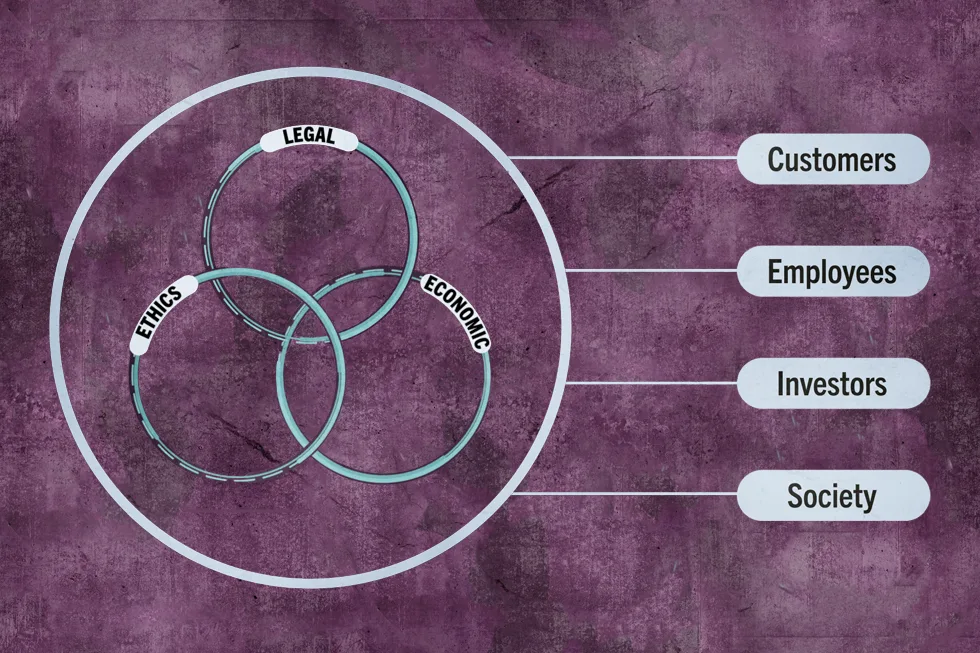
As a leader, you’re responsible not just for addressing your own conflicts, but for helping your employees work through theirs. As you do, keep your responsibilities in mind—whether ethical, legal, or economic.
Leadership, Ethics, and Corporate Accountability groups your ethical responsibilities to employees into five categories:
Well-being: What’s ultimately good for the person
Rights: Entitlement to receive certain treatment
Duties: A moral obligation to behave in a specific way
Best practices: Aspirational standards not required by law or cultural norms
Fairness: Impartial and just treatment
In Leadership, Ethics, and Corporate Accountability, Hsieh outlines three types of fairness you can use when helping employees solve conflicts:
Legitimate expectations: Employees reasonably expect certain practices or behaviors to continue based on experiences with the organization and explicit promises.
Procedural fairness: Managers must resolve issues impartially and consistently.
Distributive fairness: Your company equitably allocates opportunities, benefits, and burdens.
When it comes to procedural fairness especially, avoid taking sides while mediating conflict. Treat both parties equally, and give them each time to speak and share their perspective. Guide your team toward collaboration or compromise, and work toward a solution that achieves the goal while maintaining—or even strengthening—relationships.
Are you interested in learning how to navigate difficult decisions as a leader? Explore Leadership, Ethics, and Corporate Accountability—one of our online leadership and management courses—and download our free guide to becoming a more effective leader.
This post was updated on September 24, 2026. It was originally published on September 7, 2023.