
A strategy doesn't succeed because it's well-written. It succeeds because it's well-resourced. No matter how compelling your vision, success depends on whether initiatives receive funding, talent, and leadership support.
In the online course Disruptive Strategy, former Harvard Business School Professor Clayton Christensen emphasizes that a company’s true strategy is revealed through its decisions—not its statements. If you want to understand your company’s real strategy, he argues, stop reading the annual report.
As Intel Chairman Andy Grove says in Disruptive Strategy, “If you want to know what a company’s strategy is, don’t listen to what they say. Watch what they do. That’s the strategy.”
So what determines what a company actually does? The resource allocation process.
This article breaks down how resource allocation works within organizations, how to navigate it effectively, and how it shapes strategic initiatives' success—whether they accelerate or never leave the whiteboard.
Featured Certificate Course
Disruptive Strategy
Leverage disruptive innovation to develop winning, executive-level strategies and position your business for growth.
Self-Paced | 5 Modules | 5-6 Hours per Module | $1,949

What Is the Resource Allocation Process?
Within Disruptive Strategy, Christensen defines resource allocation as "the process by which resources are deployed to drive initiatives within a business.”
A resource allocation process isn’t inherently “good” or “bad.” It simply reflects how the organization chooses to deploy its resources, including money, people, and time. The real question is whether that process supports the strategy the company claims to pursue.
When evaluating resource allocation, leaders should ask themselves:
Does the process prioritize the initiatives we’ve identified as strategic priorities?
Does it create incentives that align with our strategy—or incentives that quietly undermine it?
Does it elevate the work that matters most, or the work that’s easiest, most familiar, or politically convenient?
This reframes strategy as an ongoing organizational process rather than a one-time planning exercise.
As Christensen puts it in Disruptive Strategy, "Strategy is a process that is at work 24/7 in every company." And at the center of that is a mechanism that most leaders underestimate: resource allocation.
How the Resource Allocation Process Works
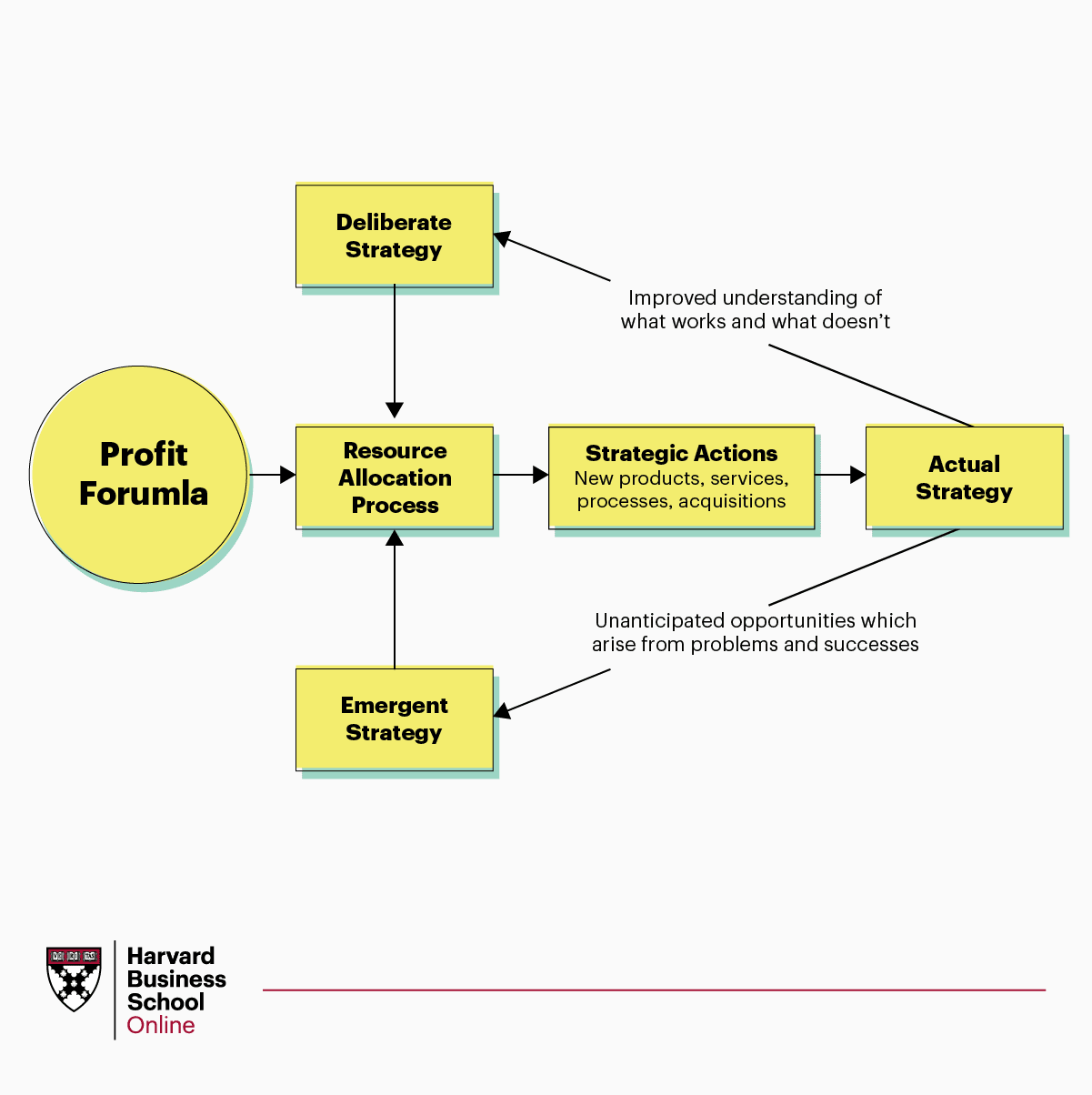
To explain how the process works, Christensen offers a simple diagram in Disruptive Strategy.
On one side, you have deliberate strategy: What leadership intends to do
On the other, you have emergent strategy: The unanticipated opportunities and problems that arise once you're in the market
Both feed into the resource allocation process, which determines the strategic actions a company takes, such as new products, services, or acquisitions. Over time, those actions become the company’s actual strategy.
Here’s a breakdown of how the process unfolds.
Recognize the Gap Between Your Stated Strategy and Actual Strategy
Once deliberate and emergent ideas enter the same resource allocation process, leaders must confront a difficult reality: Stated strategy and actual strategy often don't align.
"Ideas for what you want to do and things that you never thought about are brought into this process," Christensen explains in Disruptive Strategy. "And they battle for resources. Whatever gets funded comes out toward the right-hand side of your diagram as the products and services that you fund and that you implement in the market."
This is why, in Disruptive Strategy, Christensen argues that strategy is not a one-time plan followed by execution. It's an ongoing process shaped by repeated decisions about where money, people, and time are invested.
As a result, leaders must focus less on what the organization claims its strategy is and more on what it consistently prioritizes and funds. Only then can they begin aligning the resource allocation process with the strategy they want to execute.
Apply the Profit Formula as the Decision Lens
So how does the resource allocation process decide which ideas win?
Christensen points to the profit formula—the financial logic by which a company is structured to make money.
"Every time they have to make a decision about investing resources behind this idea or this idea, they have to have criteria by which they say, 'Oh, this is higher priority than that.' And almost always, that criteria is the profit formula,” Christensen says in Disruptive Strategy.
Two forces shape that formula: cost structure and the size of the opportunity.
1. Cost Structure
In companies with high fixed costs, the organization demands high gross margins to stay viable. As a result, ideas that promise strong margins rise to the top, not necessarily because they're the right strategic bet, but because the business model requires it.
"The criteria by which resource allocation questions get decided is they invest in either the deliberate or emergent ideas that offer the highest gross margins," Christensen explains in Disruptive Strategy.
2. Size of the Opportunity
The second criterion is the size of the opportunity relative to the company's size.
Christensen illustrates the gap in Disruptive Strategy:
A $10 million company sees a two-million-dollar opportunity as huge
A $2 billion company sees that same opportunity as irrelevant
The result: As companies grow, they become blind to the small opportunities that could fuel future growth. And as Christensen warns in Disruptive Strategy, "The big markets of tomorrow are small markets today."
Watch What Rises—and What Gets Squeezed Out
Once the profit formula becomes the default decision lens, the resource allocation process starts to behave predictably. Ideas that fit the company’s cost structure and growth expectations rise. Ideas that don’t fit struggle—even if leaders insist they matter.
As Christensen stresses in Disruptive Strategy, employees eventually begin operating by instinct, favoring the activities the organization is designed to reward and profit from.
Intel shows this dynamic in action. In the 1970s, it was primarily a Dynamic Random Access Memory (DRAM) company. When the microprocessor emerged, it had to compete for resources through the same allocation process as improvements to the DRAM business.
Each month, Intel’s leaders reviewed a list of products ranked by gross margin. DRAM margins were falling; microprocessor margins were rising.
"The resource allocation process implemented an exit from the DRAM business," Christensen says in Disruptive Strategy. “And the process orchestrated the building of a microprocessor business—without senior management ever having to make a decision about it, because the process used the criteria to get out of one and get into another."
Meanwhile, Intel’s founders kept doubling down on DRAM even after the market had moved on. By the time DRAM accounted for just three percent of revenue, the business was already in free fall.
In practice, Intel’s resource allocation decisions had already shifted away from DRAM long before leadership formally committed to the transition. Only after stepping back and returning with a fresh perspective did they fully embrace the shift the company had already begun.
How to Manage the Resource Allocation Process
Understanding that the resource allocation process exists is not enough. Leaders must learn how to shape it, because the real levers of control are rarely where executives assume they are.
Redefine the Real Levers of Control
Within Disruptive Strategy, Christensen uses the metaphor of a valve to illustrate the illusion of executive control over resource allocation.
Leaders often believe they can redirect resources simply by making top-down decisions, as though turning a valve to control the flow of water. When executives look inside, they often discover the valve isn’t hooked up to anything.
The real lever, Christensen argues in Disruptive Strategy, “Is where you define the criteria that's used in the resource allocation process.” Leaders who focus solely on approving individual projects are operating at the wrong level. The more powerful intervention is shaping the criteria by which every project gets evaluated.
Recognize the Middle Manager Problem
A second, less visible layer of control sits in the middle of the organization. Ideas originate at the base—from salespeople confronting competitors, engineers wrestling with constraints, and frontline employees observing customer needs. But those ideas don’t move upward unfiltered.
“Middle managers have a problem,” Christensen stresses in Disruptive Strategy. They cannot escalate every idea. They must choose which ones to develop, package, and champion—and which ones to quietly let die.
The result is a profound distortion: When senior leaders gather to make decisions, they believe they're choosing among the full universe of options. In reality, they're choosing from the subset that middle managers deemed worthy of attention. The real strategic gatekeeping happens long before the executive meeting begins.
This filtering effect is intensified by the promotion cycle. High-potential managers rotate roles every 18 months and are rewarded for delivering fast, visible results. As Christensen explains in Disruptive Strategy, this creates “a very powerful incentive…only to invest in projects that will yield fruit within 18 to 24 months.” Long‑horizon opportunities—often the most strategically important—struggle to find a champion.
Decentralize Resource Allocation Decisions
Christensen’s structural recommendation isn't procedural but organizational. A single, monolithic resource allocation process becomes a bottleneck—and a killer of innovation.
“The only method that we have found is never to let your company become huge and monolithic,” Christensen explains in Disruptive Strategy. "Instead, build a large company out of small, autonomous business units, each with its own resource allocation process."
When units are small, small opportunities look meaningful again. Emerging markets that seem trivial to a billion-dollar division suddenly become attractive to a $50 million unit. Decentralization restores visibility to opportunities that would otherwise be invisible.
Free E-Book
How to Formulate a Successful Business Strategy
This guide will equip you with the tools, frameworks, and knowledge to formulate a successful business strategy that propels your organization forward.
Your Strategy Is Only as Strong as What Gets Funded
You can have the sharpest vision in your industry. But if your resource allocation process is prioritizing the wrong things—through gross margin filters, size thresholds, or middle managers who never surface the right ideas—your actual strategy will drift further from your intended one every single day.
The leaders who close that gap aren't just better planners. They understand the organizational processes that shape execution.
Ready to shape where your organization invests its resources? Explore Disruptive Strategy—one of our strategy and entrepreneurship and innovation courses—and download our free strategy formulation e-book to learn how to align what your organization says with what it actually does.