
Managers rarely run out of tasks—they run out of time. The real challenge is identifying which deserve your focus.
“When managers learn something new—when they spot a problem, a risk, or an inefficiency—the instinct is to often intervene immediately," says Harvard Business School Professor Joseph Fuller in the online course Management Essentials.
That impulse is understandable. Action feels productive. But as Management Essentials emphasizes, it can also be misguided. One of the biggest obstacles to sound decision-making is failing to distinguish between what's urgent and what's important. When managers confuse the two, they spend their time reacting to immediate demands rather than focusing on what creates lasting value.
Statistics show that teams that prioritize effectively are 1.4 times more likely to outperform their peers, and 64 percent of project managers say prioritization is critical to successful project delivery. In a business environment shaped by AI, hybrid work, and constantly competing demands, the ability to distinguish between urgency and importance isn't just a useful management skill—it's a competitive advantage.
One of the most practical frameworks for developing that capability is the Eisenhower Matrix. It helps managers evaluate competing priorities and decide where to focus their time, attention, and resources.
Featured Certificate Course
Management Essentials
Explore a practical, process-based approach for everyday management in a changing world of work.
Self-Paced | 4 Modules | 5-6 Hours per Module | $1,949

What Is the Eisenhower Matrix?
Effective prioritization begins with a deceptively simple realization: urgent and important are not the same thing.
“Learning doesn't move in a straight line from insight to action,” Fuller notes in Management Essentials. “It unfolds as a cycle.”
Experience generates information, reflection turns it into insight, and only then does action become relevant. When managers skip that cycle—moving directly from observation to intervention—they risk solving the wrong problems.
That's why Fuller describes restraint as a core managerial capability within Management Essentials: “It's the discipline to keep learning when pressure pushes toward action, and the judgment to wait until understanding is sufficiently grounded to support meaningful, durable change.”
The Eisenhower Matrix offers managers a practical way to apply that discipline. Named after U.S. President Dwight D. Eisenhower, who was known for balancing immediate demands with long-term priorities, the framework organizes work into a simple two-by-two grid using two criteria: urgency and importance.
Its value lies in prompting managers to make deliberate decisions about where to invest their time. Instead of reacting to every request, the matrix helps distinguish between work that requires immediate attention, work that can be scheduled or delegated, and work that can be eliminated altogether.
Why the Eisenhower Matrix Is Effective
Urgency has a way of hijacking judgment. An email, interruption, or last-minute request can create pressure to respond immediately. Over time, managers who give in to the impulse fall into the habit of reacting instead of leading, while the work that matters most keeps getting pushed to tomorrow.
The matrix breaks that pattern by weighing urgency against importance. Instead of focusing on what's loudest, managers focus on what will make the biggest difference.
The 4 Quadrants of the Eisenhower Matrix
Each task falls into one of four quadrants based on its urgency and importance, and each quadrant points to a specific action:
Do it
Schedule it
Delegate it
Eliminate it
Together, they provide managers with a practical framework for prioritizing work and deciding what to do next.
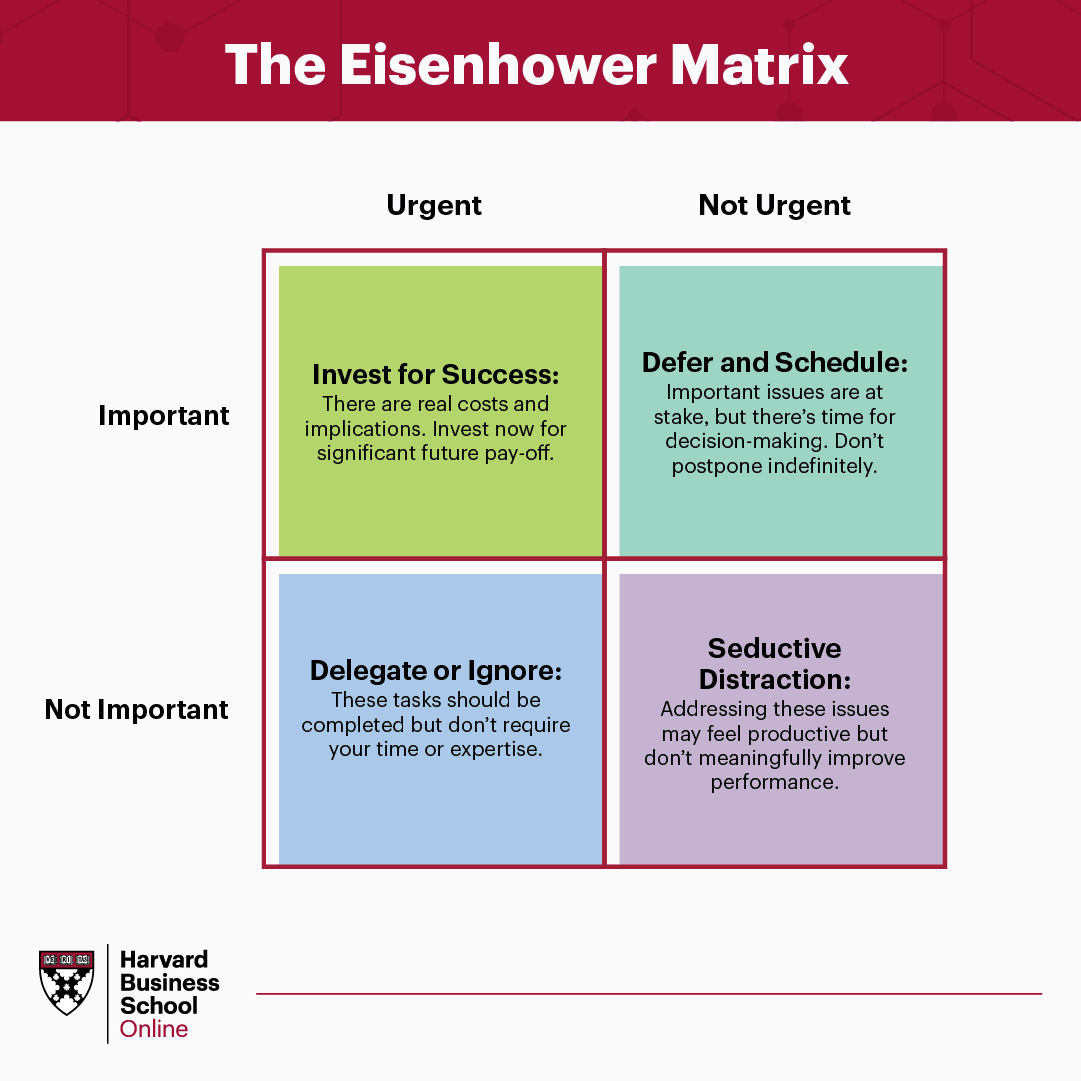
Quadrant 1: Urgent and Important
These are high-priority issues with real consequences if left unaddressed. As Fuller emphasizes in Management Essentials, managers are naturally drawn to this quadrant—and rightly so. These situations demand immediate attention but also present valuable learning opportunities. Addressing them effectively can reveal patterns, strengthen processes, and help prevent similar crises.
Quadrant 2: Important but Not Urgent
This quadrant contains the strategic work that drives long-term success, including planning, capability building, relationship development, and organizational learning. This is the quadrant the matrix is designed to protect.
As Fuller notes in Management Essentials, "smart, capable people risk postponing addressing these issues," because they rarely demand immediate attention. Effective managers counter that tendency by scheduling dedicated time for this work before it becomes urgent.
Quadrant 3: Urgent but Not Important
These tasks create pressure to respond quickly but contribute relatively little to long-term objectives. A useful question to ask is: Does this require my expertise specifically, or simply someone's attention?
Delegating work in this quadrant allows managers to focus on responsibilities where they can make the greatest impact.
Quadrant 4: Neither Urgent nor Important
In Management Essentials, Fuller describes these as tasks that "may feel productive but don't meaningfully improve performance." Whether they take the form of unnecessary meetings, habitual busywork, or avoidable distractions, these activities consume time that could be invested elsewhere. Whenever possible, minimize or eliminate them.
As organizations adapt to emerging technologies and rapid market shifts, success depends less on doing more and instead on doing the right work. The Eisenhower Matrix equips managers with a timeless framework for prioritizing strategic initiatives while avoiding the trap of reacting to every urgent demand.
How to Apply the Eisenhower Matrix in Your Daily Work
Understanding the Eisenhower Matrix is one thing. Applying it consistently amid competing priorities, constant interruptions, technological change, and evolving business demands is another challenge.
The goal isn't to remove urgent tasks—they're an inevitable part of management. It's to ensure that urgency doesn't determine where your time goes.
"Managers risk being overwhelmed if they fall into the habit of attending immediately to everything that can be characterized as urgent," Fuller says in Management Essentials.
The discipline lies in pausing before acting and asking: Is this genuinely important, or does it simply feel pressing?
Consider a hospital department head who spends most of her week responding to staffing shortages, scheduling conflicts, and patient escalations. Each issue demands attention, and many truly are urgent. Yet week after week, an employee training program she's been meaning to redesign slips further down her to-do list. It doesn't have an immediate deadline, so it always feels like it can wait until tomorrow.
That's exactly what the Eisenhower Matrix is designed to reveal. The staffing shortages and patient escalations belong in Quadrant 1, while some scheduling issues can be delegated as Quadrant 3 tasks. The training program, however, belongs in Quadrant 2: important but not yet urgent.
It's the kind of work that strengthens capabilities, enhances performance, and prevents future issues. Each week it's postponed, the risk grows. Undertrained employees make more mistakes. Mistakes become recurring problems. Those problems eventually become the next urgent crisis competing for the manager's attention.
Within Management Essentials, Fuller stresses that managers need to "pay regular attention to the important, but not-yet urgent quadrant," and resist the pull of tasks that feel pressing but don't meaningfully advance performance.
In today's workplace, that discipline is more important than ever. The most effective managers aren't those who respond to every interruption—they're those who consistently prioritize strategic work, invest in developing their teams, and build the capacity to adapt before change becomes a crisis. The Eisenhower Matrix provides a practical framework for making those decisions every day.
Free E-Book
How to Become a More Effective Leader
Explore the difference between leadership and management, the qualities and skills that characterize an effective leader, and how you can unleash the potential in yourself and others.
Start Prioritizing What Matters Most with HBS Online
Effective prioritization isn't about doing more—it's about focusing your time and energy on the work that matters most. The Eisenhower Matrix offers a practical framework for distinguishing between urgent and important tasks, enabling you to make more intentional decisions, even under pressure.
But like any management tool, its impact stems from consistent use, not merely understanding the concept.
By incorporating the Eisenhower Matrix into your routine, you can spend less time reacting to competing demands and more time advancing your highest priorities. Over time, that shift can help you make better decisions, lead more effectively, and create greater long-term impact.
Ready to become a more intentional leader? Explore Management Essentials—one of our leadership and management courses—and download our free e-book to expand your management skills and lead with greater confidence.