
When it comes to financial statements, each communicates specific information and is needed in different contexts to understand a company’s financial health.
The income statement is an essential financial document that details your company's income and expenses over a specific period. This document communicates a wealth of information to those reading it—from key executives and stakeholders to investors and employees. Being able to read an income statement is important, but knowing how to generate one is just as critical.
Here’s an overview of the information found in an income statement, along with a step-by-step look at the process of preparing one for your organization.
Free Templates
Financial Statement Templates
This resource provides a primer on the balance sheet, income statement, and cash flow statement, along with templates to create them yourself.

What Is an Income Statement?
An income statement is a financial report detailing a company’s income and expenses over a reporting period. It can also be referred to as a profit and loss (P&L) statement and is typically prepared quarterly or annually.
Understanding income statements is vital because they depict a company’s financial performance over a reporting period. Because the income statement details revenues and expenses, it provides a glimpse into which business activities brought in revenue and which cost the organization money—information investors can use to understand its health and executives can use to find areas for improvement.
Related: How to Read & Understand an Income Statement
An income statement typically includes the following information:

Revenue: How much money a business took in during a reporting period
Expenses: How much money a business spent during a reporting period
Costs of goods sold (COGS): The total costs associated with component parts of whatever product or service a company makes and sells
Gross profit: Revenue minus costs of goods sold
Operating income: Gross profit minus operating expenses
Income before taxes: Operating income minus non-operating expenses
Net income: Income before taxes
Earnings per share (EPS): Net income divided by the total number of outstanding shares
Depreciation: Value lost by assets, such as inventory, equipment, and property, over time
EBITDA: Earnings before interest, depreciation, taxes, and amortization
Related: 13 Financial Performance Measures Managers Should Monitor
Steps to Prepare an Income Statement
1. Choose Your Reporting Period
Your reporting period is the specific timeframe the income statement covers. Choosing the correct one is critical.
Monthly, quarterly, and annual reporting periods are all common. Which reporting period is right for you depends on your goals. A monthly report, for example, details a shorter period, making it easier to apply tactical adjustments that affect the next month’s business activities. A quarterly or annual report, on the other hand, provides analysis from a higher level, which can help identify trends over the long term.
2. Calculate Total Revenue
After identifying your reporting period, calculate your business's total revenue generated in that timeframe.
If you prepare the income statement for your entire organization, this should include revenue from all lines of business. If you prepare the income statement for a particular business line or segment, you should limit revenue to products or services that fall under that umbrella.
3. Calculate the Cost of Goods Sold (COGS)
Next, calculate the total cost of goods sold for any product or service that generated revenue for your business during the reporting period. This encompasses direct and indirect costs of producing and selling products or services, including:
Direct labor expenses
Material expenses
Parts or component expenses
Distribution costs
Any expense directly tied to the production of your product or service
4. Calculate Gross Profit
The next step is to determine gross profit for the reporting period. To calculate this, simply subtract the cost of goods sold from revenue.
Featured Certificate Course
Financial Accounting
Learn how financial statements are built, interpreted, and used to assess business performance.
Start Anytime | 5 Modules | 8-9 Hours per Module | $1,949
5. Calculate Operating Expenses
Once you know gross profit, calculate operating expenses (OPEX).
Operating expenses are indirect costs associated with doing business. These differ from the cost of goods sold because they’re not directly associated with the process of producing or distributing products or services. Examples of expenses that fall under the OPEX category include:
Rent
Utilities
Overhead
Office supplies
Legal fees
6. Calculate Income
To calculate total income, subtract operating expenses from gross profit. This number is essentially the pre-tax income your business generated during the reporting period. This can also be referred to as earnings before interest and taxes (EBIT).
7. Calculate Interest and Taxes
After calculating income for the reporting period, determine interest and tax charges.
Interest refers to any charges your company must pay on the debt it owes. To calculate interest charges, you must first understand how much money you owe and the interest rate being charged. Accounting software often automatically calculates interest charges for the reporting period.
Next, calculate your total tax burden for the reporting period. This includes local, state, and federal taxes, as well as any payroll taxes.
8. Calculate Net Income
The final step is to calculate net income for the reporting period. To do this, subtract interest and then taxes from your EBIT. The number remaining reflects your business’s available funds, which can be used for various purposes, such as being added to a reserve, distributed to shareholders, utilized for research and development, or to fuel business expansion.
Income Statement Format and Example
Below is an example income statement for a fictional company. As you can see at the top, the reporting period is for the year that ended on Sept. 28, 2019.
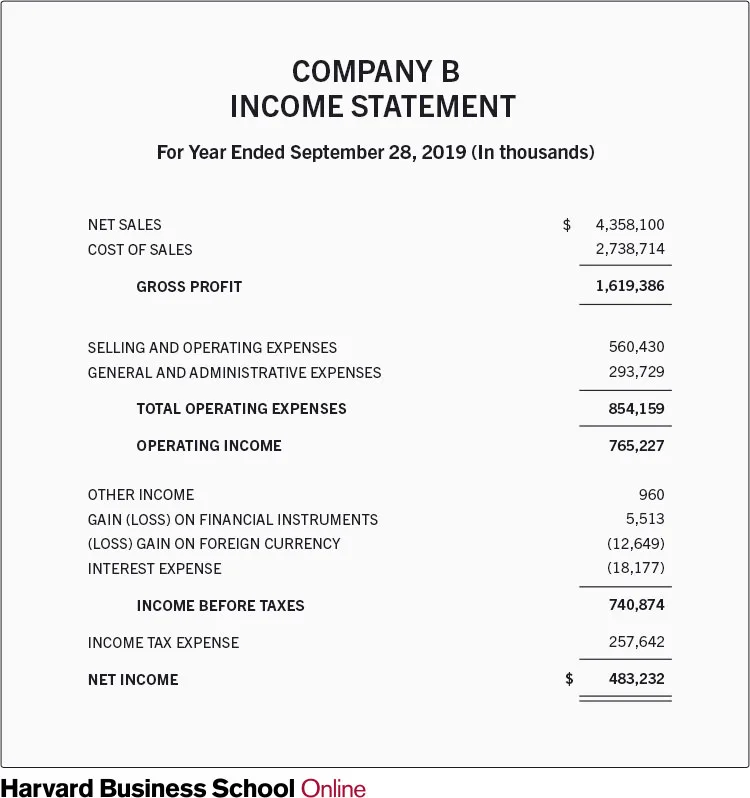
Data Tables: Company B Income Statement
For Year Ended September 28, 2019 (In thousands)
| Activity | Amount |
|---|---|
| Net Sales | $4,358,100 |
| Cost of Sales | $2,738,714 |
| Gross Profit | $1,619,386 |
| Selling and Oprating Expenses | $560,430 |
| General and Administrative Expenses | $293,729 |
| Total Operating Expesnes | $854,159 |
| Operating Income | $765,227 |
| Other Income | $960 |
| Gain (Loss) On Financial Instruments | $5,513 |
| (Loss) Gain on Foreign Currency | ($12,649) |
| Interest Expense | ($18,177) |
| Income Before Taxes | $740,874 |
| Income Tax Expense | $257,642 |
| Net Income | $483,232 |