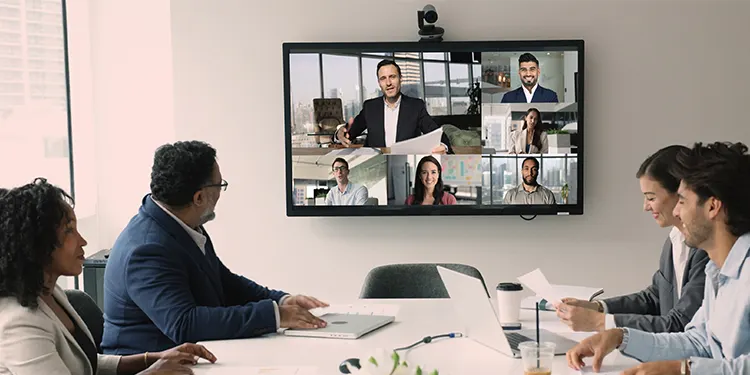
Taking on a management role means creating the conditions your team needs to thrive. But managing people across cities, time zones, and countries requires more than moving meetings online. Managers must establish the systems, expectations, and culture that help employees collaborate effectively—even when they rarely share the same physical space.
That need has become increasingly important as hybrid and remote work continue to shape the modern workplace. Gallup reports that 52 percent of employees work in a hybrid environment, while 26 percent are fully remote and 22 percent work entirely on-site.
Distributed teams can deliver exceptional results when managers intentionally foster communication, accountability, and connection. This guide explores how to build and manage high-performing distributed teams while supporting professional growth, meaningful contributions, and long-term impact.
Featured Certificate Course
Management Essentials
Explore a practical, process-based approach for everyday management in a changing world of work.
Self-Paced | 4 Modules | 5-6 Hours per Module | $1,949

What Is a Distributed Workforce?
A distributed workforce is a group of employees who work from different locations rather than sharing one physical office. These employees work across remote and hybrid settings and rely on digital tools to collaborate.
Traditionally, offices provided more than a place to work. They also made it easier for employees to coordinate projects, learn from one another, and track progress. As Harvard Business School Professor Joseph Fuller, who teaches the online course Management Essentials, explains, “Until recently, people tended to work together in one physical location. Whether it was an office, a factory, or a campus, these spaces were 'where work happened.'”
Distributed work changes how organizations build trust, share information, and promote employee performance. The goal is not simply to replicate the office online. It’s to create processes that help people work effectively, regardless of location.
Although the workplace has changed, the core responsibilities of management remain. As Fuller notes in Management Essentials, “When work becomes distributed, the need for those functions remains, although they have to be carried out in different ways.”
Here’s an overview of how organizations can manage effective distributed teams in today’s business world.
Common Challenges of Managing Distributed Teams
Without regular face-to-face interaction, managers must be intentional about supporting performance, maintaining morale, and keeping projects aligned with organizational goals.
As Fuller shares in Management Essentials, some of the most common challenges of managing a distributed team include:
Persistent ambiguity: Without informal conversations and immediate clarification, uncertainty about priorities, responsibilities, and expectations can quickly grow.
Sparse learning opportunities: Distributed employees have fewer opportunities to learn by observing their colleagues, making coaching, knowledge-sharing, and professional development more difficult.
Unclear team norms: Without shared workplace norms, employees may develop different approaches to communication, collaboration, meeting participation, response times, and decision-making.
Limited visibility: When employees work across different locations, managers may have less insight into their progress, contributions, and challenges.
Understanding these challenges is an important first step. Addressing them requires managers to rethink how they communicate, coordinate work, support their employees, and build effective team processes.
How to Manage Distributed Teams: 6 Key Tips
1. Prioritize Written Communication
Distributed employees can’t rely on chitchat or overheard updates to understand priorities. To bridge this gap, managers should document the team’s vision, goals, project plans, and important decisions in clear, accessible formats.
Written communication is especially important for employees working across different time zones. It gives everyone a reliable source of information they can reference when needed, rather than making access dependent on attending a particular meeting or working at a specific time.
Hayden Brown, CEO of Upwork, an online platform that connects businesses with freelance employees, emphasizes this point in Management Essentials: “Written communication becomes extremely important to set direction and provide clarity.”
For example, managers can send a weekly team update outlining primary objectives, responsibilities, and upcoming deadlines. This central reference point can keep employees aligned and help surface questions or potential delays early.
2. Be Accessible and Responsive
With fewer opportunities for face-to-face interaction, managers should be accessible when team members need support or issues arise. Doing so can foster psychological safety, improve coordination, and keep projects moving forward.
As Brown explains in Management Essentials, “The manager has to be extremely responsive to course correcting and checking in with the team on what’s going on, and that is part of the accountability job—knowing where things are, knowing what’s on track or off track, and then actively problem-solving those things with team members.”
Being responsive doesn't mean staying constantly online or solving every problem yourself. Instead, schedule regular one-on-one check-ins, offer office hours, and establish clear escalation procedures. These systems give employees reliable access to support while allowing responsibility and decision-making to remain distributed across the team.
3. Design Clear Collaboration Norms
Distributed teams need explicit agreements about how work gets done. Managers should create expectations for meetings, response times, documentation, and the appropriate use of communication channels.
“Teams that perform well in remote or hybrid settings understand that distributed work is different, and they design mechanisms to ensure they can perform acceptably," Fuller says in Management Essentials. "They define how information is shared, how decisions are made, and how progress is tracked, rather than relying on informal interactions.”
When employees don't work side by side, they have fewer opportunities to absorb team norms through everyday observation. Managers must make expectations explicit.
For example, your team's collaboration norms might include:
Using email for formal decisions and project documentation
Using Microsoft Teams or Slack for time-sensitive questions
Responding to internal messages within one business day
Recording meeting notes in a shared project workspace
Established norms reduce uncertainty and give employees a consistent framework for communicating.
Explore four strategies for effectively managing remote teams to strengthen communication, build trust, and keep employees connected in the video below, and be sure to subscribe to our YouTube channel for more explainer content.
4. Build Intentional Learning Opportunities
In a standard office setting, employees can learn by observing how their colleagues work and absorbing knowledge through day-to-day interactions.
Structured onboarding, training, mentorship, and professional development are especially important in distributed environments. These opportunities help employees expand their skills, maintain motivation, and build stronger connections with their colleagues.
As Fuller emphasizes in Management Essentials, “Onboarding, development, and knowledge transfer are designed intentionally rather than left to observation or osmosis.”
Managers can reinforce intentional learning by providing:
A structured onboarding plan with goals for the first 30, 60, and 90 days
A designated mentor
Opportunities to observe meetings and project workflows
Regular one-on-one check-ins for questions and feedback
Recorded training sessions and easily accessible documentation
By replacing informal observation with deliberate learning experiences, managers can help distributed employees develop their skills and integrate into the team.
5. Diagnose System Problems Early
When a distributed project falls behind, avoid immediately assuming an employee is underperforming. First investigate whether unclear communication, inadequate tools, confusing roles, or cross-team dependencies contributed to the problem.
In Management Essentials, Brown warns that a common mistake is “thinking that it’s the employees” when the real cause may be “a system or a system design issue.”
Before addressing an individual performance concern, review the project’s structure, scope, tool access, team norms, and dependencies. Ask yourself:
Were expectations clear?
Did the employee have the information, tools, and resources needed to complete the task?
Did another team, unclear decision-making authority, or an external dependency cause delays?
Did the communication process give the employee opportunities to ask questions or raise concerns?
This diagnostic approach can help managers identify root causes, provide appropriate support, and avoid treating a system failure as an individual performance issue.
6. Create Regular Opportunities for Connection
Remote and hybrid teams can miss the spontaneous conversations and shared experiences that strengthen workplace relationships. Managers can create purposeful opportunities for employees to interact, whether through virtual social gatherings, lunch-and-learns, or periodic in-person meetings.
As Brown shares in Management Essentials, these gatherings can help teams “build social fabric" and create a forum for raising and solving difficult problems.
The goal isn't simply to add more meetings. It's to create meaningful opportunities for team members to build relationships, discuss issues that may not surface during routine project work, and celebrate shared successes.
By creating space for those interactions, managers can help distributed employees strengthen their relationships with one another and stay connected to the team's broader purpose.
Free E-Book
How to Become a More Effective Leader
Explore the difference between leadership and management, the qualities and skills that characterize an effective leader, and how you can unleash the potential in yourself and others.

Shape a Distributed Team That Performs
Managing a distributed team successfully requires more than adopting remote-work tools. Leaders also need deliberate practices that bolster communication, collaboration, and learning. When these practices are thoughtfully designed, employees have the structure and support they need to do their best work—regardless of location.
Assess how your team works today, then focus on a few high-impact changes. Clear norms, early attention to system problems, and meaningful development opportunities can help distributed teams achieve lasting success.
Ready to strengthen your distributed teams? Explore Management Essentials—one of our online leadership and management courses—and download our free e-book to sharpen your managerial skills.